Welcome To My Blog. I respect and appreciate comments, questions, information and theories you might have. Even if i agree with you or not, i won't delete your comments as long as they are not purposefully attacking anyone. I will not condone bullying of any kind. If you that is your intent, don't bother posting because i will delete it the moment i see it.

Friday, January 10, 2020

After A Decade In Prison, The Man Convicted Of Peggy Hettrick's Murder Was Exonerated. So Who Is The Real Killer?

Peggy Hettrick
Image result for Peggy Hettrick

She was a artistic, vivacious, fun-loving red head. She had a lot of ambitions, one of those was a novel, a fiction piece about diamond smugglers, that she was writing on her typewriter.

In 1987, Peggy was 37 years old and working at the Fashion Bar, a department store that sold ladies’ and men’s apparel at The Square at the corner of College Avenue and Horsetooth Road, in Fort Collins, Colorado.

On February 10th, 1987Peggy finished her shift at work and clocked out at 9:01 p.m. She did not own a car so she walked the few blocks to her Aspen Leaf apartment on Stover Street. Once there she realized she was locked out. Peggy banged on the door, but her friend, who was staying with her, was passed out drunk inside and would not answer. Peggy went bar hopping briefly while she was locked out. Peggy then walked back to her residence, changed clothes and headed back out. 

Peggy had spent the rest of the night at the Prime Minster Bar at the corner of College Avenue and Boardwalk Drive. Her on-again, off-again boyfriend, Matt Zoellner, claimed he arrived at the Prime Minister at about 12:30 a.m. and bumped into Peggy while he was waiting for another woman. He offered Peggy a ride back to her apartment. She said OK, but after Zoellner returned from the bathroom, he said, he saw her walking out the door.

The next morning, Peggy’s grandmother arrived at her apartment. The two had planned to go out to breakfast and do some shopping. Peggy was not there. The light was still on in her bedroom.

That same morning, roughly six hours after Peggy was seen leaving the bar, a bicyclist on his way to work saw what he thought was a mannequin in an open field at the 3500 block of Landings Drive, less than 500 yards from the Prime Minister. Upon closer inspection, it wasn't a mannequin at all, it was Peggy's dead body. 
Image result for peggy hettrick fort collins
The police were called and they descended on the scene. A half-smoked cigarette sat in a pool of blood that had gathered at the nearby curb and a bloody drag trail headed from it into the field.  This lead investigators to believe that Peggy had been dragged from another location, perhaps a car parked by the road.
Image result for peggy hettrick fort collins
Peggy had been stabbed once in the back and had cut marks on her face, pelvis and breasts. Her arms were up above her head. Her purse was twisted around her arm and her watch was still on her wrist. Around her neck there was a gold chain necklace with a gold charm of the Blessed Mother. All her jewelry seemed to be all in place and her nails were perfectly manicured with pink polish. 

Investigators believed that this was a sexual homicide and the killer had put Peggy on display. They also theorized that he had a lot of skill with a knife due to the partial vulvectomy that had been performed.

With bare hands, casts were taken of tire tracks and footprints. Photographs were snapped and any evidence that could be found was collected.

Meanwhile, investigators canvased the neighborhood. Their first stop was a trailer that belonged to a man named Clyde Mathews. The trailer sat at the top of a small hill overlooking the field where the body was discovered. Clyde's 15-year-old son Tim also lived there. Clyde told police that he'd seen his son deviate from his usual path across the field to the bus that morning.
Image result for tim clyde peggy hettrick
At the time, Tim was a five-foot-ten, 120-pound high school sophomore at Fort Collins High School. The other kids called him “Toothpick.” He was awkward, introverted, and an outcast. 

Tim grew up just outside San Diego. His father, a Vietnam veteran, was stationed there as a chief petty officer with the U.S. Navy. When Tim was in second grade, the family moved to Fort Collins. They settled into the trailer while Clyde finished his last few years in the service in California. The transition was tough for Tim, he seemed isolated and withdrawn. Even though he had above average intelligence, he had problems in school and counseling was suggested.

Tim's dad retired in 1982 and moved to Fort Collins. Things seemed to be getting better until February 11th, 1983. Tim was in sixth grade and his mother was not feeling well. Clyde drove her to the hospital and Margaret Masters died of toxic shock syndrome the next day.

Clyde Masters, was still grieving the loss of his wife and would often take out his anger by yelling at Tim. During this time, Tim was busted twice: once for shoplifting some toy cars from Target, and once for vandalism. A middle school counselor, Ann Livingston, told investigators that Tim was shy and that he was not doing well in school. “He appeared to miss his mom,” she said.

Tim often withdrew into his drawing. The pictures were mostly about monsters or war, often grotesque and showing a lot of blood. “He was very interested in the armed forces,” Livingston told police, “and was very enthusiastic whenever his sister came home for visits.”

During his first semester of 10th grade, teachers did notice a preoccupation with racism and cruelty, weapons, militarism, and death. And a few weeks before Peggy's killing, a teacher tried to confiscate an Army manual Tim was reading in class. Furious, he refused to hand it over and stormed out of the classroom.

When police pulled Tim out of class for questioning, he admitted that he had saw the body on his way to school, but he thought it was a mannequin and someone was playing a trick. However, he allegedly told a classmate that he first thought that it was just a mannequin in the field that morning, but when he got closer he saw that it was really a dead body. 
He even drew his classmate a map of where he found the body.

On February 12th, Tim was brought into the police station. Investigators asked him if they could question him alone and he agreed. That also garnered his father's permission as well. After 6 hours of interrogation, wherein policemen repeatedly told Tim they knew he'd committed the murder, Tim maintained his innocence. He was then administered a lie detector test, which he failed.

Later that day, investigators searched his home, including the sinks for blood, and his school locker. What stood out first to detectives was a knife collection displayed on his dresser. Next to the knives was the local newspaper with the account of the body's discovery
Investigators also found 2,200 pages of writings and violent artwork in his bedroom, backpack and school locker, along with pornography. 

The coroners report stated that Peggy had been killed by two knives. One knife was supposedly like a scalpel for mutilation and a bigger knife was used for killing. Two hairs were found on Peggy along with unknown fingerprints on her purse. The knives could not be linked to Peggy's murder. No trace of Peggy's blood or hair was found in Tim's room or among his belongings, including his clothes and knife collection. Also, the hairs found on Peggy, along with the unknown fingerprints on her purse, did not match Tim either.

On February 12th, 1988, desperate to get some kind of criminal reaction out of Tim, investigators planted an article containing false information in the local newspaper, but it didn't work.

In 1992, an interview with a former classmate revealed that Tim told his friends details about the sexual mutilations. The investigators thought this information had never been made public or disclosed to Tim or his defense attorneys. Convinced that only the murderer would have known those details, Tim was interviewed again. Investigators traveled to Philadelphia, where Time was serving in the Navy. He told investigators that a friend in his art class had told him about the mutilations. The friend had been part of a group of Explorer Scouts helping the police search the crime scene, and he was told of the nature of the mutilations early in the investigation. Allegedly, his story checked out.

In 1996, Dr. J. Reid Meloy, a forensic psychologist from California,  analyzed Tim's writings and artwork extensively. He concluded that some of the drawings represented Tim reliving the crime.

August 10th, 1998, detectives went to Tim's house with an arrest warrant and he was brought to Fort Collins for trial.

In March of 1999, based on the testimony of Dr. Meloy and others, and Tim's own drawings, including a drawing of a body being dragged, Tim was convicted and sentenced to life in prison for Peggy's murder. Though some jurors had doubts about his guilt, his drawings and writings were cited by jury members as compelling evidence against him.

After mounting several appeals, the state appointed a new defense team who immediately began investigating the case. The defense team discovered that evidence, including the hairs found on Peggy and photographs of the fingerprints found in her purse, was missing. During 2007 hearings, the defense alleged police and prosecutorial misconduct in the investigation and trial. The defense argued that Jim Broderick perjured himself during the 1999 trial concerning his involvement in the case. Also, it was alleged that  prosecutors withheld evidence, DNA test results of skin cells left on Peggy's clothing pointed to Peggy’s on-again-off-again boyfriend, Dr. Richard Hammond.
Image result for dr. richard hammond peggy hettrick
In 1987, Hammond was an eye surgeon in Fort Collins. He was a 98-pound weakling. He wore thick glasses since he was 3 years old and he grew up to be a bookworm with splayed feet who had no athletic acumen whatsoever. He was quiet and gentle and kind of a wimp, until he started body building. His house was close to where Peggy's body was found, which you could see from the upstairs bedroom and bathroom. And he was home the morning after the murder, despite his usually scheduled surgeries on that day of the week. 

In April 1987, a block from where Peggy’s body was found, a man that was described as square-jawed, muscular and in his mid-20's flashed a woman. In 2011, the victim in that case looked at a picture of Hammond and said he looked like the flashing suspect.

Beginning around 1992, Hammond rigged an elaborate videotaping operation that would secretly film the genitals of females who used the toilet in his home’s downstairs bathroom. He created hundreds of videotapes; many images were extreme close-ups of genitals.  His victims ranged in age from early teens to mid 40's, and included friends of his children and his wife, babysitters and house sitters. Hammond was arrested in 1995 after a house sitter discovered the elaborate setup. 

Investigators search his house and found the rigging and thousands of dollars worth of pornography hidden in a locked office and in a storage shed in town. 

Hammond committed suicide in March 1995 at a La Quinta Motor Inn in north Denver. He had used an IV needle containing cyanide.  "My death should satisfy the media's thirst for blood," he wrote in the suicide note.

Though investigators noted a possible link between Hammond and the Peggy's murder, no follow up investigation was done. Since he had committed suicide and therefore he couldn't be tried for anything, Broderick ordered evidence in the Hammond case destroyed before it could be examined for any link with Peggy. The information about the arrest of Dr. Hammond, and his subsequent suicide, was withheld from Dr. Meloy and the other experts, and the FBI was not informed of this case.

A judge vacated Tim's conviction and he was released after a decade in prison in 2008. Wearing a black suit, white button-down shirt, and yellow-print tie, he walked out of the Larimer County courtroom unchained.

The DNA testing that led to the 2008 overturning of Tim's conviction also implicated Peggy's sometime boyfriend, Matt Zoellner, a young used car salesman, who liked pretty women, cold beer, and cocaine. He also had testified at Tim's trial. DNA found inside the waistband of Peggy's panty lines and under the cuffs of her blouse matched Zoellner’s profile.  Zoellner was initially a suspect in 1987, but was quickly ruled out. Officials plan to renew the investigation.

Following his release, Tim filed a civil case, and the city and county agreed to a settlement that paid Masters and his attorneys $10 million. Then, in November 2010, the residents of Larimer County voted overwhelmingly to kick Judges Gilmore and Blair off the bench.

In an announcement on June 28th, 2011, it was announced that Tim was no longer a suspect in Peggy's murder a was exonerated.

To this date, no one has been charged in Peggy's murder.

Thursday, January 9, 2020

Wonderful Amy Johnson Was The Queen Of The Air.

Amy Johnson
flygirls-Amy_Johnson_portrait.jpg
"Queen of the air"

Amy Johnson was born at 154 St George's Road in Kingston upon Hull, Yorkshire, England to Amy Hodge and John William Johnson, a member of the family fish merchants firm of Andrew Johnson, Knudtzon and Company. Amy was the eldest of the four daughters. 

She was educated at Boulevard Municipal Secondary School (later Kingston High School) and the University of Sheffield, where she graduated with a Bachelor of Arts degree in economics. She moved on to work as a secretary to a London solicitor and became interested in flying. She was told by her first instructor that she'd never be a pilot, but in 1928 she proved them wrong when she gained an aviator's certificate and a pilot's license, both at the London Aeroplane Club. In that same year, she became the first British woman to obtain a ground engineer's licence.

Amy wanted to fly solo to Australia and to beat Bert Hinkler's record of 16 days. She obtained the funds for her first aircraft from her father and eventually won financial backing from Lord Wakefield. She purchased a second-hand de Havilland DH.60 Gipsy Moth G-AAAH and named it Jason after her father's business trade mark.

On May 5th, 1930, with only 75 hours of flying time Amy set off from Croydon in South London on her solo flight to Darwin. On the fourth day a sandstorm forced her to land and she spent several with her gun in hand and the desert dogs barking in the distance. 

Several days later, after leaving Karachi in what is now Pakistan, she realized she didn't have enough fuel to get her to her next stop, so she made an unscheduled landing. Johnson flew through monsoon rains and in blistering heat and made several crash landings that caused delays while improvised repairs were made to her plane. And at one point, after making an unplanned stop in an Indonesian village, she was reported missing.

It was an epic flight of 11,000 miles.  She missed the record by three days, nevertheless she was the first woman to fly alone to Australia and was dubbed “Queen of the Air” by the British press.

Later, Amy remarked, "The prospect did not frighten me, because I was so appallingly ignorant that I never realized in the least what I had taken on."

In 1931, she and co-pilot Jack Humphreys became the first to fly from London to Moscow in one day. They completed the 1,760 miles  journey in approximately 21 hours in a de Havilland DH.80 Puss Moth G-AAZV which Amy named Jason II. From there, they continued across Siberia and on to Tokyo, setting a record time for Britain to Japan.

In 1932, Johnson married Scottish pilot Jim Mollison, who had proposed to her during a flight together some eight hours after they had first met. That year, she also broke the record for solo flight, which had been held by her new husband, to Cape Town, South Africa by 11 hours in Puss Moth G-ACAB, named Desert Cloud.


The following year the newly-weds undertook a joint flying mission non-stop from Wales for New York in a G-ACCV, de Havilland DH.84 Dragon I named "Seafarer." Ignoring his wife's advice, Mollison refused to refuel in Boston and headed to Floyd Bennett Field in Brooklyn. They ran out of gas over an airstrip in Connecticut, They overshot the runway trying to land their plane in the dark and crashed in a drainage ditch. Both were thrown from the aircraft but suffered only cuts and gashes. When Amelia Earhart heard about the accident she invited them to stay at her house while they recovered. After recuperating, the pair were feted by New York society and received a ticker tape parade down Wall Street.

The couple also flew, in record time, from Britain to India in 1934 in G-ACSP, named "Black Magic", a de Havilland DH.88 Comet as part of the Britain to Australia MacRobertson Air Race. They were forced to retire from the race at Allahabad because of engine trouble.

In May 1936, Amy made her last record-breaking flight, regaining her Britain to South Africa record in G-ADZO, a Percival Gull Six. The same year she was awarded the Gold Medal of the Royal Aero Club.

In 1938, Amy overturned her glider when landing after a display at Walsall Aerodrome in England, but was not seriously hurt. The same year, she divorced Mollison. Soon afterwards, she reverted to her maiden name.

In 1939, during the outbreak of World World II, the Royal Air Force invited her to join the newly established Air Transport Auxiliary, which was ferrying aircraft from factories to air bases. She rose to first officer.

On January 5th, 1941, had been on a routine mission, flying a  Airspeed Oxford from Prestwick to Kidlington when she went off course in adverse weather conditions. Reportedly out of fuel, she bailed out as her aircraft crashed into the Thames Estuary near Herne Bay. A convoy of wartime vessels spotted Amy's parachute coming down and saw her alive in the frigged water, calling for help. 

The weather was terrible and the tide was strong as the snow was falling as Lt Cmdr Walter Fletcher, the Captain of HMS Haslemere, navigated his ship to attempt a rescue. The crew of the vessel threw ropes out to Amy but she was unable to reach them and was lost under the ship. Some people believed that Amy was sucked into the blades of the ship's propellers, but no one witnessed this however and Amy was never seen again.

A memorial service was held for Amy in the church of St Martin-in-the-Fields on January 14th, 1941.

As a member of the ATA with no known grave, she is (under the name Amy V. Johnson) commemorated by the Commonwealth War Graves Commission on the Air Forces Memorial at Runnymede. 

During her life and after her death, Amy was honored in many ways. I will only mention of few of them since there are so many. A song was written about Amy called, Wonderful Amy.  From 1935 to 1937, Johnson was the President of the Women's Engineering Society. The British Women Pilot's Association award is an annual Amy Johnson Memorial Trust Scholarship to help outstanding women pilots further their careers.

In 1999, it was reported that Tom Mitchell, claimed to have shot sixteen rounds of shells Amy's aircraft down when she twice failed to give the correct identification code during the flight. Mitchell explained how the aircraft was sighted and contacted by radio. 

"We all thought it was an enemy plane until the next day when we read the papers and discovered it was Amy. The officers told us never to tell anyone what happened."

The Bones In The Box: Joseph Mulvaney.

Joseph Junior Mulvaney
Image result for Joseph Mulvaney
He was born on January 3rd, 1921 in Illinois to Joseph Henry Mulvaney and Kathryn Goar Mulvaney. He was the only child for the couple. He was very loved and adored, especially by his mom. She beamed with pride, that boy was her life!

On April 8th, 1929, Joseph fell from the barn loft at his grandpa's house and broke his left arm below the elbow.

On March 27th, 1939, He was 18-years-old when he almost died in a mud/gravel slide. He was saved by 2 friends.

On September 21st, 1940, after the near death from the mudslide he enlisted in the national guard to serve his country. His father and his grandfather, come from a long line of soldiers that fought for our country.

His uncle Dore Mulvaney was killed in World War 2. Even with all of that, he signed up and become brothers with the men from Decatur national guard 130th division 133rd.. Enlisted on March 5th, 1941 and was honorably discharged in 1945.

His mama became sick with tuberculosis and passed away while he was overseas in Australia on June 4th, 1945, she was 50 years old. 


He then worked for the railroad in Illinois in 1945 and moved to California and continued to work for the railroad as a brakes man from 1946 to 1960. He met and married Mary Alyce McLees and they had 3 children. Mary Alyce had a child from a previous relationship named John David Morris.
They moved to the Des Moines area around 1961 and purchased a home of their own. Shortly after they signed the paperwork to buy their house, Joseph Mulvaney disappeared. He was never reported as a missing person.

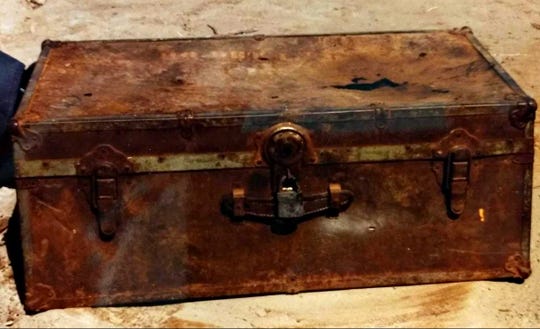
Fast forward to April 1992. Newell Sessions decided it was time to open the old trunk on his property in Thermopolis, Wyoming. The padlocked footlocker sat in a shed that had been given to him in 1987 by an acquaintance, John David Morris, with the agreement Sessions would move the shed off Morris' property. Sessions took the shed, but never bothered to open the trunk. 
This trunk, opened in Wyoming in 1992, contained the remains of an Iowa man who disappeared in 1963. He wasn't positively identified as Joseph Mulvaney until 2017. Examination of the bones showed  Mulvaney had been shot through the eye and in the chest.
When Sessions cut through the lock with a torch and opened the footlocker, he found a human skeleton, wrapped with a piece of plastic, along with a belt and a rotted grocery bag. His wife told him to call the sheriff.

When questioned, Morris claimed that he had purchased the trunk at a yard sale and local law enforcement believed him, except sheriff John Lumley. He thought that Morris knew more than he was saying, but had no proof.

Authorities would later discover a bullet lodged in the skull and evidence that the victim had been shot in the chest. They had no clue as to the victim's name, age, time of death or a location where the crime was committed.

The bag inside the trunk with the bones was from a Hy-Vee, which led authorities to wonder if the remains were of an Iowan.

A computer rendering of what the homicide victim might have looked like was released by the Hot Springs Sheriff's Office in Wyoming.

When Shelley Statler saw the story in a local paper her father told her that the bones might belong to Shelley grandfather. Shelley and her mother, Kathy Mulvaney Guynn, tried to contact authorities for years to no avail. Finally, in 2017, officials agreed to test Guynn's DNA against the bones. It was a 99 percent match. These were the bones of Joesph Mulvaney.

Shelley believes her grandfather was shot and killed in Des Moines, put in the trunk and buried in the backyard of her grandmother's home, until Morris dug them up and took them with him to Wyoming.

"I don't think my grandparents had a very good marriage, and I know it affected my mom and her siblings growing up," Shelley said. "My grandmother wasn't always easy to get along with."

Mary Alyce died in 2009.

No charges have been filed for the murder of Joseph Mulvaney.

Joseph's remains were released and his family had a military service for him march 2019 at Ballard funeral home in Cody, Wyoming.

Traci Hammerberg Never Made It Home From The Party. Her Friend, Wendy Smith Was Murdered A Year Later.

🌞Traci Lynn Hammerberg🌞
Image result for Traci Hammerberg
She was very social with a wide variety of friends. She was quiet, friendly and sweet. 

Traci was born March 7th, 1966 to Judy Klabunde and Harlan Hammerberg in Milwaukee, Wisconsin. The family moved to Saukville, Wisconsin in 1976 where Traci had attended Port Washington High School. 

She had a habit of running away in the past, but in December of 1984, she was back living with her mother, stepfather, Robert R. Luebke and half sister, Jennifer Luebkeand. Traci also had a boyfriend who had recently moved to North Dakota. She always wore his class ring and had plans to join him.

On Friday, December 14th, 1984, Traci babysat from 7:20 p.m. to 9:45 p.m., at a house on Dries Street in Saukville. Afterwards she decided to walk to S&S Foods, on West Dekora Road and Tower Street, to meet up with friends. She was dressed in a nice pair of jeans, a light green sweater and a dark green jacket. 

From the grocery store, Traci and her friends got in a car and went to Quade's Tavern in Port Washington. There she bought a six pack of beer and told the bartender that she was going to a party. 

After the tavern, Traci and her friends went to a party on South Garfield avenue. There they played a beer drinking game and smoked marijuana. At midnight, one of her friends' brothers arrived at the party. They decided to go to S&S Foods and asked Traci if she wanted a ride, but she declined.

Around 12:30 a.m., Traci left on foot for 3.7 mile walk along Wisconsin Highway to her home at South Mayfair Drive in Saukville. She would often walk from Portland to Saukville and often would accept rides from friends as well as hitch hike.

At 5:45 a.m., a hunter, that lived on Maple Road, went outside of his home to retrieve his hunting gear when he saw a mid-sized dark colored sedan with their lights off, peeling out of the driveway next door and head south on Maple Road. At the same time, another hunting in the nearby woods, saw the same vehicle. 

Another resident, on Maple Road was on his way to work when he came across Traci's battered body laying in his snowy driveway. She let out a moan and then was silent. The resident ran inside and called the sheriff at 6:25 a.m. He then went back outside and stayed with Tracy until the sheriff arrived. 

Traci was half naked with blood in the snow and trees around her. An open pack of Marlboro cigarettes were at her feet. She had been raped, strangled and had multiple skull fractures from a metallic object. The autopsy stated that she died of her head injuries. It also revealed that she had tried to fight off her attacker.

DNA was recovered from the scene and a Behavioral Analysis Unit assisted with creating a criminal profile. The Sheriff's office interviewed hundreds of witnesses. More than 400 men were eliminated as suspects through blood typing and DNA analysis.
Image result for wendy smith 1985 port washington
A year later, Wendy Smith, a friend and former classmate of Traci was found dead. Her death was ruled a homicide while her cause of death was investigated. In 1985, Wendy was 18 years old and was reportedly walking from a friend's house to a tavern where her mom worked. She came upon Thomas Kirsch near the hill where N. Wisconsin Street meets Johnson Street. It's unclear what happened next, but her body was found more than 24 hours later on the hillside, and Kirsch was convicted of first-degree murder and second-degree sexual assault. (That is all i could find on Wendy. If you have a picture of Wendy or anymore information about her life, please post it or let me know.)

In March of 2019, a breakthrough finally came thanks to an emerging science known as genetic genealogy. Combining physical evidence left on Hammerberg's body with public DNA databases like MyHeritage and GEDmatch, investigators identified the killer's second cousin. 
Image result for Philip J. Cross
From there, they worked through a family tree until they landed on Philip J. Cross.

Cross and Traci might have known each other, but they weren't friends. Traci's brother, Ricky, remembered Cross from school. He road the same bus that they did. Ricky stated that Cross liked to pick fights on the bus, beat people up and others were afraid of him.

Cross was a loner and living with his parents on Green Bay Road in Port Washington at the time time of Traci's murder. He had been released from Dodge Correctional Institute in April of 1984. He would have been 21 years old at the time of Traci's death and was working the graveyard shift at Rexnord Plastics in 1984. Authorities suspect that Traci was picked up by Cross, in his 1972 Fury, after he left his work shift the night she was killed. His vehicle matched the description the hunters had given to police back in 1984.

Cross briefly attended Port Washington High School in 1978 before being incarcerated in Ethan Allen School in Whales, Wisconsin. He had called in bomb threats to a school and stole a car.

While at Ethan Allen School, he went missing three times. He was released in 1981.

In 1982, Cross was in the Ozaukee County Jail on drug and other charges. He cooperated with police and acted as an informant to develop cases on local drug dealers.

Police found Cross had a history of violent outbursts, as well as a history of drug use. He had a temper when he didn't get his way, once punching a hole in the wall during a fight with his girlfriend in 1983. After the fight Cross committed forgery and was incarcerated Dodge Correctional Institute until April of 1984.

September 26th, 1985, Cross was listed as a witness in a prowler complaint. A woman that worked at the same plant that Cross did, arrived home from work at 2 a.m when she saw someone in her bushes. Cross came up to the woman a few moments later, saying that he saw someone running away.

While working at the plant, he received complaints for leaving vulgar notes to coworkers, using bad language towards others, having bad work habits, a bad attitude and causing damage to machinery.

In 1988, Cross married and moved to Sheboygan where he attempted to strangle a women with his belt while she was giving him a ride home from a tavern. The woman escaped. She told authorities that she didn't know what had set him off and that she feared for her life. Cross later admitted to the incident, but claimed it happened differently.

Police were called to his home over 15 times for domestic violence issues. There were also allegations that Cross assaulted a young girl and abused alcohol and drugs.

In 2012, an arrest warrant was issued for Cross after he threatened hospital staff over the phone after not being allowed to see his girlfriend. When officers found 48-years-old Cross, he was unresponsive at the Diamond Inn motel with a crack pipe nearby and a needle in his lap. He had died of an overdose.

Authorities speculated that Traci rejected Cross' sexual advances and that the man went into a rage while he raped and killed her. 

Cross' DNA was analyzed and it was a match for that taken from Traci's murder scene. Cross also smoked the same brand of cigarettes that were found by Traci's body.


Traci's sister, Lorri Sell, said that she was grateful detectives never gave up on the case.

Wednesday, January 8, 2020

Who Killed The West Virginia Nun, Roberta Elam?

👼Roberta Ann "Robin" Elam👼
Image result for Roberta Ann "Robin" Elam
She was a brilliant, gregarious young woman who drove an orange sports car, jogged and hiked, wrote poetry about the mountains that soared above and laughed as often as possible.

Roberta was born on August 23rd, 1950 in Ramsey County, Minnesota. She was the oldest of four children and grew up in Minnesota and Illinois before moving with her family to New Jersey. While in graduate school at Fordham University, she became friends with fellow student Sister Kathleen Durkin.

Inspired by a pastoral letter written in 1975 by Catholic bishops from Appalachian states, Roberta went to work for the Wheeling-Charleston diocese after earning her master's degree in religious education. Over the next two years, her friendship with Sister Kathleen deepened while they traveled and taught adult religion classes in small towns around the state. 

In the fall of 1976, she entered the Sisters of St. Joseph and moved into its mother house the following June. 

On the morning of June 13th, 1977, 26-year-old Roberta had spent the last eight days in her convent in Wheeling, West Virginia, in silent retreat contemplating her final vows to become a nun. She grabbed an apple out of the kitchen and then with bible in hand, walked to a nearby hill behind Mount Saint Joseph to pray and meditate. Why she was kneeling down to pray, Roberta was attacked, raped, then strangled to death by hand and left near an overturned park bench. Her brutal rape and murder occurred within earshot of the Speidel Golf Course, but no one there heard a thing. 

A caretaker discovered Roberta's body behind an overturned bench at 2 p.m. Investigators found no signs of defensive injuries, and they determined Elam had been incapacitated.

Her death followed the then-unsolved slayings of four other young women over the previous seven months in adjoining Washington County, prompting Pennsylvania State Police to consult with investigators in Wheeling.

West Virginia State Police homicide investigator Don Shade was called to lead the investigation two weeks after the murder. By the time he saw the murder scene, cigarette ashes were all over the place, and the chances of obtaining any forensic evidence were slim. An area of nearby weeds remained mashed down, indicating the killer had lain in wait for her. It was determined that Roberta's killer very strong and crushed her larynx. Police obtained blood samples from everyone they could think of and questioned hundreds of people, including a drifter trying to hop a train and members of a Georgia-based salvage crew who had been working on telephone poles in the area.

A drawing was released of a white man in his 30's, with dirty, dark hair, bushy eyebrows, a mustache and a beard who had been seen near the Mount St. Joseph grounds. They sought but never found a rusty, gray or faded-blue Chevrolet or Buick, festooned with religious and coal-mining bumper stickers, that had been parked on nearby Pogue's Run Road.

People who knew her were eliminated. And despite all the leads that were followed and the DNA evidence collected from the scene, the case went cold.

Since her case was reopened in 2001, there are new witnesses and suspects. Similar crimes committed elsewhere or by serial killers have also been looked at. The genetic profile contained in the DNA sample from Roberta's killer was submitted to the nationwide DNA database known as CODIS.

The killer's DNA profile was also directly taken to more than 170 individual labs that do DNA testing for law enforcement agencies. They asked the labs to compare that profile with other DNA samples they've collected that did not meet requirements for entry in the CODIS system but remain in unsolved-case files. They did this in case someone had a partial DNA profile that doesn't meet CODIS standards.

There is a possibility that there was two killers. 
Image result for convicted murderer Eugene Blake
Convicted murderer Eugene Blake was considered after Department of Corrections documents exposed the distinct possibility that Blake may have been roaming around the Wheeling area in the mid 1970's when he was serving life without the possibility of parole in the state penitentiary at Moundsville. However, DNA evidence was not linked to Blake. Authorities said that they also believed that a second killer could have been with him at the time.
Image result for john george shoplak
A local man, John Shoplak, had been eliminated in early in the original investigation as well. His blood-type didn't match the killers. However, he knew details of the case that had never been made public. At the time of the murder, Shoplak’s former girlfriend told investigators that her ex “did not like Catholic people,” and that he had once tried choking her. The two broke up the month before Roberta was killed.

Shoplak's daughter said that despite his beliefs that he would have never attacked anyone.

Shoplak had also been accused of raping two girls, but allegedly he was protecting the real perpetrators and took the rap.

He was convicted of robbing his grandmother. In the process of the burglary, Shoplack cut off his grandmother’s finger to steal a ring and wrapped a telephone wire around her neck to stop her from screaming. 

One of Shoplak’s former friends told the Wheeling police in September 1977 that Shoplak had attacked and murdered a nun near Oglebay Park. Shoplak allegedly said he had approached her from behind and used a belt to strangle her. He had then allegedly told his friend that she was on her period or was a virgin and got blood on him.

Shoplak died in 2019 and the authorities are trying to track down his DNA from the hospital he was in before he died.

Anyone with information about Miss Elam's killing can contact Lt. Cuchta at 304-234-3741 or Sgt. Swiger at 304-329-1101.