Welcome To My Blog. I respect and appreciate comments, questions, information and theories you might have. Even if i agree with you or not, i won't delete your comments as long as they are not purposefully attacking anyone. I will not condone bullying of any kind. If you that is your intent, don't bother posting because i will delete it the moment i see it.

Monday, December 30, 2019

Was Patricia Webb Murdered Because She Was A Narcotics Informant Or Was She Murdered By A Serial Killer?

Patricia Carol Webb
Image result for Patricia Webb nebraska
She was popular, beautiful, considerate, loving responsible and trustworthy with a restless spirit. She was very involved with needlework, ceramics and crafts. Patricia Webb loved to roller skate and often took her folks with her to the rink just north of 48th and O streets.
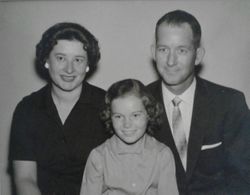
Patricia was born on July 2nd, 1949 in Burnwell, Kanawha County, West Virginia. She born to Robert "Bob" Webb's brother. 
Picture of
She was adopted by Bob and his wife Joan Webb after Patricia's birth mother died when she was 4 years old.

Patricia grew up in south-central Lincoln, Nebraska in a modest white ranch with a Cornhusker-red door. She attended Calvert Elementary School and Pound Junior High. In July of 1967, Patricia was chosen "Miss Nebraska" at the North Central Regional Amateur Roller-Skating championship in Kansas City. She later won a silver bar representing Nebraska at the national championships in Lincoln. 

Patricia graduated from Southeast High School in 1968. After her graduation, Patricia married in October wearing a gown of satin with a high-rise bodice and double lace ruffle. A satin pillbox held her veil, and she carried Tropicana roses centered with a single orchid. Patricia and her husband  separated less than a year later. In April of 1970 they were divorced and the court restored her maiden name. Patricia had difficulty deciding what she wanted to do in life. She tried attending the University of Nebraska twice before deciding that wasn't for her.

In 1974, 24-year-old Patricia was a new employee of the Adult Book and Cinema Store. She disappeared overnight on April 18th, along with 51 bondage-themed adult magazines, a calculator and $30. A cord leading to an extension from a pay phone had been cut and the shop door left unlocked.
Image result for Patricia Carol Webb Lincoln Nebraska
On April 20th, Oscar Fiene went to feed cattle on a vacant farm he owned east of Hallam and spotted a blue jacket sleeve and patch of thigh barely visible under a haystack.
Image result for Patricia Webb Lincoln Nebraska
Patricia’s bullet-riddled body was nude under the hay, except for a quilted jacket, one of 143 extra-large jackets distributed by a feed mill and given to customers or sold to employees. Patricia had a piece of tape over her mouth. She had been dead for at least 12 hours.

The Adult Cinema and Book Store had been open for two years. In the early 70's the idea of being able to buy pornography and take it home was new. When the Adult Book and Cinema at 140 S. 11th St. opened, the town was shocked. Everyone thought that the Mafia ran such stores, along with gambling, drugs and prostitution. So when the body of the pretty young clerk turned up full of lead, people began wondering if the Mafia knocked her off.

Patricia's case was being handled as a typical homicide, until two days later.  Authorities disclosed that the state, county and local police were coordinating an around-the-clock search for the person or persons who murdered her, because she had been an informant for the narcotic division of the Nebraska State Patrol since the fall of 1973. At the time of her murder, Patricia had stopped undercover work in early 1974 and wanted to start again, but she owed $3,000 to $4,000 to finance companies and was told that she couldn't be reinstated until she got those bills straightened out.

Patricia was supposed to testify in court the day she disappeared. She also would have testified in at least one future case. Half a dozen drug cases had to be dismissed when Patricia failed to show up to testify. The cases were for small amounts of amphetamines and marijuana. The attorney at the time said that the cases were nothing big enough to make someone desperate enough to kill her.

Patricia and another undercover informant played key roles in late 1973 and early 1974, setting up 60 or 70 undercover drug buys leading to the arrests and convictions of more than two dozen people.

Police never found the .22- and .25-caliber guns that ended Patricia's life. Investigators believed the .22s were fired from a rifle, most likely a Mossberg, and the .25s from a semi-automatic handgun like a Beretta Panther 418 or Tulski Korovin.

Investigators suspected that there were two killers and that they moved the body, because little blood was found nearby.

Police never found her clothes, but her purse turned up in a ditch a mile and a half away.

Witnesses came forward to say they saw a young woman leave the store with a black man at about 1 a.m. on April 18th and get into a large, older car that looked like a boxy Cadillac or Buick and may have had another person inside.

Police developed two strong suspects, a man matching the description that witnesses gave and his partner, a white man, but they couldn't definitively connect them to the slaying.

Image result for ottis elwood toole
Ottis Elwood Toole became a prime suspect in Patricia's murder. He was an American serial killer and drifter. He sometimes would also sometimes participate in the murders committed by serial killer Henry Lee Lucas. 


Toole was born on March 5, 1947, in Jackson, Florida. His father was an alcoholic and mother an abuser. Toole was sexually assaulted as a child by his elder sister, close relatives and neighbors.

Toole’s grandmother was a Satanist. She exposed young Toole to various Satanic practices and rituals, such as self-mutilation and grave robbing. She often called him as "Devil's Child".

Toole suffered from mild mental retardation and epilepsy which caused frequent grand mal seizures. He was a serial arsonist and was sexually aroused by fire. Toole often ran away from home, seeking shelter in abandoned homes.

When he was 5, Toole he was forced to have sex with his father’s friend. By the age of 10, Toole realized he was gay and had his first sexual relationship with a young boy from neighborhood at 12. He visited gay bars often and became obsessed with gay pornography. By his teen years, Toole became a male prostitute.

In 1962, Toole was 14-years-old when he committed his first murder. A travelling salesman propositioned him for sex. The incident infuriated Toole so much so that he ran over the salesman with his own car. 

Between 1966 and 1973, Toole moved to Southwestern region of America. With no job and no career aspect to fall back upon, he supported himself through prostitution and panhandling.

In 1974, Toole was living in Nebraska at the time Patricia was killed. Soon after her murder, he moved to Boulder, Colorado. While in Boulder, he was accused of  murdering 31-year old Ellen Holman. Despite being accused, Toole left Boulder and moved back to Jacksonville.

On January 14, 1976, Toole married a woman 25 years older than him. The marriage lasted three days. On the third day, upon discovering his homosexuality, she left him. Later, Toole said that he got married in attempts to hide the fact he was gay.

In 1976, is when Toole first met Henry Lee Lucas at a Jacksonville soup kitchen. The two had sexual relations. He was an accomplice to Lucas  in 108 murders.

In January 1982, when Toole was living in Jacksonville, he had a sexual relationship with George Sonnenberg.  One day they argued and Toole set the house on fire. Sonnenberg died a week later due to injuries sustained from fire.

In April 1983, Toole was arrested for an unrelated arson incident in Jacksonville. He was sentenced to 20 years in prison. Two months later, his friend Henry Lucas was arrested for unlawful possession of firearm. It was during their time in prison that the two confessed about their murder rampage.

In October 1983, Toole confessed that he had kidnapped, raped and brutally murdered 6-year old Adam Walsh in 1981.

In April 1984, Toole was found guilty of first degree murder and was sentenced to death. Same year, he was convicted of the murder of a 19-year-old Tallahassee, Florida woman whom he strangled to death. He received yet another death sentence but later got both the death penalties were converted to life imprisonment.

In 1984, Toole confessed of being the man behind the two unsolved northwest Florida slayings. He admitted that he had killed 18 year old David Schallart and Ada Johnson.

Toole never confessed to Patricia's murder. He died on September 15th, 1996 at Florida State Prison due to cirrhosis. Since no one from his family came to claim his body, he was buried in the Florida State Prison Cemetery.

A composite sketch of one of the men reported to have been at the adult store the night Patricia Webb was abducted and killed was put together and released. The sketch is close to that from the Marianne Mitzner case. Due to other similarities, it’s been investigated whether or not they involved the same perpetrator. 
Image result for Patricia Webb Lincoln Nebraska
It seems, so far anyway, that there is no concrete evidence that they are the one in the same, but i'm going to talk about Marianne and the man that killed her anyway. In my mind, he is a suspect until proven other wise.

Marianne Anderson Mitzner

Image result for Marianne Mitzner
She was born on November 27th, 1924 to Ralph Clarence Anderson and Mabel Eleanora High Anderson. She married  Kenneth Laurence Mitzner on February 14th, 1952.
Marianne shot and killed -
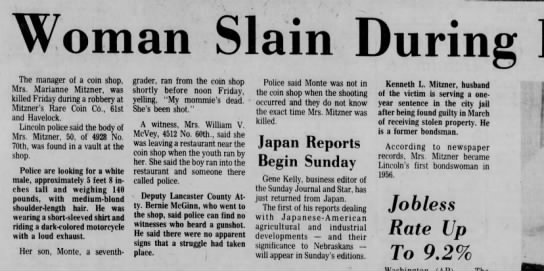
On June 6th, 1975, Marianne was 50 years old when her son, Monte, found her in the bathroom of the Mitzner Rare Coin Shop on 6106 Havelock Avenue, which she owned with her husband. Her son ran into the street screaming his mommy had been shot.

When police arrived they concluded that a robbery. Marianne was shot 3 times in the head. One of the shots had the point of entry in the mouth of Marianne. Marianne’s hands and feet were also tied when she was found.

A suspect was immediately identified as a man last witnessed in the shop as: Caucasian male, 5’8" tall, 140 lbs, medium blonde shoulder length hair. He was said to be wearing a short-sleeved shirt and riding a dark colored motorcycle.

Quite a few rare coins and money were missing as identified by the husband.
Image result for wesley peery nebraska
The man identified and convicted of Marianne’s murder is Wesley Peery.  Peery, was an employee of Nebraska Wesleyan University. On the day of the murder, his supervisor, Darwin Penrod, had sent to the Action Locksmiths, which was right next door to the coin shop. Peery also had bought a gun from the lady's apartment he was living in. The gun was a RG .22 caliber revolver. It had eight lands and grooves with a right-hand twist for rifling. One of the metal fragments removed from Marianne's brain had four lands and grooves and because the fragment appeared to be half of a .22 slug.

Peery had more evidence against him. There was rare coins, that had been stolen from the coin store on the day of the murder, found in his apartment. Tags from watches stolen on the day of the murder were found in his car. The rope that Marianne had been tied up with, match that from Peery's work as well as the rag that was stuffed in her mouth.

Peery had a long disturbing past. In 1932, he was 8-years old when he set fire to his family's rental house. He started young, stealing bikes and cars, pulling a gun on a police officer in 1939. He burglarized a sorority, broke into a house, was arrested for shooting a farmer he worked for and held up a Havelock gas station. In 1956, he broke into the Lincoln Assistant Police Chief's home near 37th and J, stealing the officers gun and using it six days later to rape a woman in Sarpy County. He raped again in Ohio a year later. She was seven months pregnant. She lost her baby and was placed in a mental hospital. He served 15 years. 

Peery was sentenced to death for Marianne's murder. He died in 1988 of a heart attack. Sometime before he died, Peery told lawyers he'd killed 13 people. As far as i can find, he never said that he murdered Patricia. but he confessed to killing a woman named Nancy Parker. 

Nancy Ellen Morrison Parker
Image result for Nancy Parker Nebraska
She was a graduate of Roosevelt High School at Des Moines. She attended Iowa State College. While there she was a member of the Alpha Gamma Delta sorority. Nancy graduated college in 1955, with a major in institution management. While at Iowa State College, she met a man named Darrel Parker and the two fell in love. Nancy and Darrel married in the spring of 1954.
In 1954, Darrel Parker was an Iowa State grad and was hired as Lincoln's first forester. He and Nancy moved into a city-owned house in Antelope Park at 3200 Sumner. 

Nancy had been working in research and advertising since July 1955 at Gooch Milling Co. She also appeared on KOLN-TV in the creative cookery program where she demonstrated recipes. Nancy planned her work schedule and often traveled out of town.
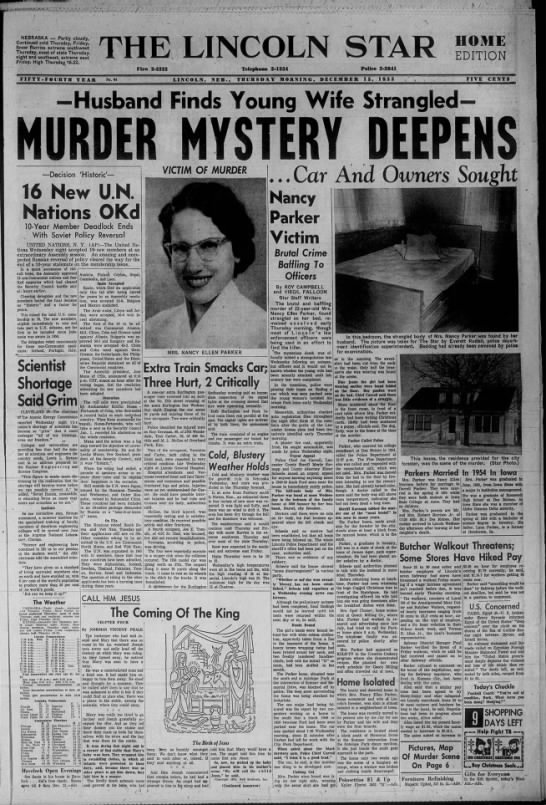
On December 14th,1955, Darrel had been trimming the town's Christmas tree before coming home for lunch. When he arrived he found the partially clad body of 22- year old Nancy on their bed. She had been beaten and her hands were bound with a white cotton clothesline that had been taken from the basement. Heavy brown wrapping twine had been twisted around her neck and she had been gagged with her husband’s handkerchiefs. 

Darrel called the police at 12:07 p.m. The fire department was also called. The firemen moved Nancy from the bed to the floor in a futile attempt to bring her back to life.

A doctor was then called to the scene. He surmised that Nancy hadn't been dead long, because her body was still above room temperature. An autopsy was preformed later and showed that Nancy had been raped and strangled.

The was little sign of a struggle. It appeared that Nancy was writing Christmas cards and their puppy, Rudy, might have scattered them about.

Darrel told police that Nancy had mentioned that she was going to town after breakfast dishes were done. Also, Nancy's boss had called the house since 8 a.m., but no one answered until the police picked up around noon.
Antelope Park - Murder Nancy Parker - Dec 15, 1955 Pg 1 - The Lincoln Star -
The deep snow surrounding the home was checked for footprints. Police began searching for a black car which was seen parked in front of Nancy's house the morning she was murdered. They had a partial license plate number and a cast of the tire tracks. They eventually found the owner of the vehicle, Wesley Peery.

Peery, a co-worker of Parker’s who had a criminal record, was questioned because his Ford had been parked nearby that morning. But Peery said he often drove through the area taking his mother to work. After Peery passed a polygraph test, the police didn't pay him anymore attention.

Two weeks before Nancy's murder, there was an attempted burglary at their home. A window was broken and there were clothes tossed about.

Darrel was in Iowa for his wife’s funeral when he was summoned to help with the investigation. He was not told he was a suspect,but when he returned to Lincoln, he was put in a windowless room  and hooked up to a lie detector. Darrel was then questioned by John Reid, a noted Chicago criminologist and polygraph expert. At one point Reid, allegedly grasped Darrel by the chin, stroked his head “as if I were some kind of animal” and threatened he’d “fry” if he didn’t produce his wife’s missing watch. It never was found.

Reid also accused his wife of “refusing relations” and suggested she “was probably running around with another man.

Darrel claimed that his marriage with Nancy was sound. In several hours of questioning he repeatedly denied killing his wife. But, after Reid taking details from investigators and feeding them to Darrel over and over again, Darrel confessed to killing his wife. The next day, he recanted his confession, but it was too late. The investigators wouldn't look at anyone else for Nancy's murder and they wouldn't stop until they had Darrel behind bars.

Darrel maintained his innocence through the investigation, the trial, the 13 years he served at the Nebraska State Penitentiary. Peery wound up there too. He had been convicted of rape that was eventually overturned. While at the same prison, Peery taunted Darrel, saying: “Darrel, if your folks could put up money for my bond, I can lead you to the guy who killed your wife. I can tell you where the suitcases (belonging to Mrs. Parker) are." Darrel didn’t even know suitcases were missing.

In 1969, a federal appeals court ruled Darrel's confession involuntary and reversed his sentence. But the U.S. Supreme Court reversed that ruling and Darrel's case was sent back to Lancaster County for a new hearing on the confession. The prosecutor said that if Darrel would waive the hearing, the state would recommend commuting his sentence, and he could stay free on parole. Parker waived the hearing. 

In 1975, Peery was back in prison. This time he was on death row for Marianne Mitzner's murder. Having heard rumors about Peery’s possible involvement in Nancy's murder, his attorneys asked him if it was true. Peery took credit for it right away. 

Perry recalled where he parked, the snow that reached the tops of his overshoes, the shotgun he carried. He knew someone was home when he saw a car parked outside. He went to the door anyway. "I put the gun on her and I said 'this is a robbery' and she backed up into the house." 

He told the lawyers what she'd been wearing that morning. He told them she reached into her purse and gave him $10. He described the kitchen closet she opened when he told her he needed rope so he could tie her up. He was able to describe the layout of the house. He even drew a blueprint with correctly placed furniture. He described distinguishing marks on her body, from her wrist and the desk where he found the 2 books of S&H Green Stamps he took when he left. He recalled checking on her, still bound in bed, as he ransacked the home. "I don't think she was dead at this time but I knew she would be before she was found."

Peery also said he’d taken Nancy’s watch and eventually fenced it.

Peery also confessed to other murders, the whole time grinning like a jackal. His lawyers couldn't divulge anything that he had told them in confidence and so they sat on the terrible recounts of murder that he was so proud of.

It wasn't until after Peery died in 1988 in prison of a heart attack did his attorney's come forward wit the awful truth.
Image result for darrel parker nebraska
Darrel was pardoned in 1991, but he kept up his efforts to formally clear his name. In 2012, He finally got an apology from the state's top prosecutor and a $500,000 judgment from the state of Nebraska for his wrongful conviction.

Patricia Webb's parents both have passed on. Over the years, her case has been looked at time and time again, but it remains unsolved.

You can submit a tip about any cold case homicide by contacting the Nebraska Information Analysis Center via the Missing Persons Hotline at 877-441-5678 or by email at NEfusioncenter@nebraska.gov.

Sunday, December 29, 2019

Help Catch Julianne Stallman's Killer.

Julianne Stallman
Image result for julianne stallman butte montana
"Justice will not be served until those who are unaffected are as outraged as those who are."
-Benjamin Franklin

She was born on May 12th, 1953 in Butte, Silver Bow County, Montana to Ronald and Mary Navarro.

She was the sweetest and nicest person ever. She was polite, energetic and just a good person.

In 1994, Julianne had 2 grown children John, 22 and Jennifer, 21. She lived on a rundown street on California Avenue in Butte, Montana.

November 29th. 1994, 41-year-old Julianne just got off of work at a restaurant on Harrison Avenue. She stopped at two stores on her way home. She had put up a Christmas tree and started wrapping gifts. At around 3:30 p.m., Julianne was brutally stabbed to death in her own home.  She had been stabbed 25 times in a prolonged battle with her attacker. She had suffered multiple wounds to the chest, and her throat had been slit.

The son was the first to stumble on to the horrific scene when he came home around 6 p.m. Julianne was dead on their kitchen floor. The crime scene was covered in blood, and there were several spatters on the fridge, walls and cabinets.

The murder weapon was never found. Investigators believe Julianne could have been attacked with a knife that her killer stole from the kitchen. 

It was theorized that after Julianne was first stabbed, she tried to escape the kitchen and make her way toward the front door. The offender, however, then pulled her back into the kitchen and inflicted the final, fatal stab wounds. He then moved her body afterwards.

It is also surmised that she knew her attacker and that they were full of a lot of rage at the time of Julianne's murder.

Julianne had been involved in two love triangles. One with her ex-husband, Van Stallman, and his wife, Sherry Stallman, and another with her former boyfriend, Brian Skinner, and his girlfriend, Jamie LeProwse.

After the homicide Brian Skinner showed Julianne's daughter Jennifer a letter he allegedly received a couple of months before the homicide telling him how Julianne was cheating on him.
Julianne’s clothing was analyzed, and unknown male DNA was found on her jeans and shoes. The unknown male DNA sample was tested against that of Skinner’s, Van's and close family members’, and they have all subsequently been eliminated as the source of the DNA.

An unknown male DNA profile had been recovered from a rug and hand towel found at the scene. 

If you remember anything at all, no matter how small, please call Butte Crimestoppers at 406-782-7336, or Butte police at 406-497-1120.

“I’m not sure if it’s because people are afraid to come forward,” said Julianne's daughter. “I’m not sure if they think maybe the information they have or what they saw isn’t important. I’ve always from the very beginning said, ‘what you think is not important could be the one piece that they need.’”

 Justice for Julianne Stallman

Every year, Julianne's family decorates her grave for Christmas. And every day they wait for justice to be served.

Cassidy Senter's Abduction and Murder Was Solved, But What About Angie Housman's?

💜Angie Housman💜
Image result for angie housman
“She’s always proud about what she’d make in school,” said Angie's mom. “She’d come in and say, ‘Look, Mommy!’ She is always happy. Very outgoing. She’d always tell me if she was going to a friend’s home.”

Angie was bright, happy, friendly and outgoing. She loved to make new friends and play in the parks by her house. She was a girly girl who loved Barbie dolls and anything pink and purple, who loved school and had dreams to become a nurse’s aide when she grew up.


Angie was born on February 18th, 1984 in Saint Louis, St. Louis City, Missouri to Diane M. Housman.

On November 18th, 1993, she was a 9-year-old fourth grader at Buder Elementary School. She lived with her mother, 29-year-old Diane, stepfather, 34-year-old Ronald “Ron” Bone, and 2-year-old half-brother, Ronald Jr. Their home was a duplex 
in the 3500 block of Wright Avenue. in St. Ann, a quiet suburb of St. Louis, Missouri.

It was about 4 p.m. when Angie got off the school bus at the intersection of Wright Avenue and St. Gregory Lane, just eight houses up the street from her bus stop. Unfortunately, none of the three children who often walked home with Angie after school were there that day.

Sometime around 5 p.m., Ron returned home to find Diane and  two-year-old Ron Jr. napping on the couch. He noticed that Angie’s white and blue book bag was missing from its usual spot on the living room floor. He became concerned when he realized she wasn’t in the house. Ron and Diane frantically searched the area with the help of several neighbors until 7:00 p.m., when someone flagged down a passing police car.

Just ten days earlier, an 11-year-old girl from nearby Maryland Heights who physically resembled Angie was ambushed after getting off the school bus, dragged into the bushes, and sexually assaulted by a older white male. After the attack, the stranger tried to guide the girl into his white car, but she broke free and ran away screaming. The suspect in that case was still on the loose and investigators wondered if this mad man had Angie.

Ron told police he last saw Angie before he left for working that morning. Going on the assumption she was abducted, police immediately launched an all-out search for Angie. The St. Louis Major Case Squad got involved in the investigation on November 22, making it the first time they had stepped into a non-murder case since 1967.

Nine days after Angie's abduction, at about 11:15 a.m., a deer hunter found her body tied to a tree 91 feet from Mueller Road, in the Busch Wildlife Conservation Area in St. Charles County. Ice chips had formed on her body.   She was gagged with a piece of fabric torn from her own underwear and had duct tape wrapped around her face, leaving only a small space for her nose to breathe. Her hands were bound behind her back with a pair of handcuffs, which were secured to the tree using a rope.

Her clothing, backpack, and a Dollar General Store bag containing ripped pieces of her underwear were discarded about 20 feet from her body. Investigators were able to lift a fingerprint off the duct tape, but it did not prove to be very helpful: it was from a part of the finger that usually is not printed, so it could not be linked to anyone even if the killer’s prints were on file. Also recovered from Angie’s body were some dog hairs and carpet fibers that likely came from an older-model vehicle.

An autopsy revealed that Angie had been held captive and beaten, tortured, and sexually abused throughout the last week of her life. Her hair had been cut and recolored, and there were deep lacerations to her thigh and both wrists. She was deprived of food and water the entire time. It is believed that she was brought to the wildlife area within 24 hours of her death. Her cause of death was hypothermia and it was surmised that she died only hours before she was found.

Investigators believed that the killer knew Angie or her family, and that he was familiar with the local area. The day before she disappeared, Angie told her teacher that her uncle was going to take her out to the country on November 18th, but she did not have any relatives who lived out in the country or were planning on taking her anywhere. 

Law enforcement has also looked into whether other cases could be related to this one. A link was sought between it and that of Cassidy Senter.


🎀Cassidy Jacquelyn Senter🎀
Image result for Cassidy Senter.

"Beauty Was In Her Face, Heaven In Her Eyes, In Every Gesture Was Kindness And Love.
You Will Live In Our Hearts Forever......"

She was born on June 9th, 1983 in Madison County, Missouri to Rhonda Senter. 

In 1993, Cassidy and her mom lived together in the lower half of Michael Goldbeck’s home on Tall Tree Court in Hazelwood, St. Louis County. Cassidy was a ten year old 5th grader at Garrett Elementary School in Hazelwood Missouri.

On December 1st, Cassidy returned home from school and then briefly visited with a neighbor, Mr. Goldbeck. Mr. Goldbeck tested Cassidy’s personal alarm to make sure it was functioning properly. 

Whenever Cassidy left home without an adult, she took her "pal" with her: a yellow battery-operated personal alarm that emits a piercing noise when activated.

After she was sure that her pal was working properly, Cassidy left home at about 3:30 p.m. and headed up Tall Tree Court. She was on her way to a friend’s that was two blocks away to decorate a Christmas tree. She was last seen at an intersection where Tall Tree Court became Spring Forest Lane.

Close to the same time, Mr and Mrs. Hanneke, who resided on Spring Tree Forest Lane next door to Cassandra Quinn, Brooks sister, heard a noise and followed the sound to identify it. The Hannekes found a yellow alarm and a pen near their property line. The alarm was buzzing. A telephone installer who happened to be nearby had told them it was a personal alarm like the one he had just purchased for his wife. But the alarm carried no identification, and they had no idea whom to contact. Not knowing the significance of their find, they buried it to silence it.

Cassidy never arrived at her friend's house and her friend thought that she had changed her mind.

A few minutes after 5:00 p.m., Rhonda returned from work. It was dark and she was worried that Cassidy wasn't home yet, so she called Cassidy’s friend’s house and she learned that Cassidy had never arrived. 

Rhonda also called her own mother in a nearby nursing home. Cassie's grandmother told one of the nursing home employees about her granddaughter's disappearance and mentioned the personal alarm.

Coincidentally, the employee, Diane Cordes, immediately thought of the small shrieking gadget her husband and neighbors had discovered in her front yard earlier that afternoon and called the police.

After Ronda and Mr. Goldbeck frantically searched for Cassidy, and came up empty, Mr Goldbeck telephoned the police as well. Around the same time, Mr. Goldbeck received word that Cassidy’s personal alarm was found on the Hannekes’ lawn. When Mr. Goldbeck told this to the police, the police instituted a ground and air search almost immediately. The search continued for days with the assistance of hundreds of volunteers.

Cassidy's school friends made pins of pink ribbons and tied other pink ribbons to mailboxes and lamp posts and Rhonda appeared on a news conference. She held back tears as she pleaded for her daughter's abductor to let her go.

"Please just leave her in a public place and give us a call to let us know where she's at. We just want her home," Pleaded Rhonda.

On December 9, 1993, two boys walking in the city of St. Louis discovered Cassidy Senter’s body in a littered alley near Martin Luther King and South Grand Boulevards. The child was wrapped in two bed comforters and a pink curtain. Her jacket and sweater were pulled above her chest. Her jeans were pulled down over her ankles, inside out. A sheet was looped around each of her ankles and then tied in the middle to hold the ankles together.

The autopsy revealed decomposition on the upper portion of her body and at least four tears to the scalp and multiple fractures in the skull. There were bruises on Cassidy’s chin, right check, right shoulder, breast bone, abdomen each side of her chest wall, and on the upper back at the base of the neck. Numerous other bruises were found over her body.

The condition of Cassidy's scalp indicated that she was alive when she received many of her injuries. The physician who performed the autopsy opined that there were at least significant five blows to the head and concluded that Cassidy died from the head injuries.   It appeared that Cassidy lived less than an hour after the blows were sustained.

Examination of tire tracks left at the scene where the body was found revealed a unique tire pattern that could have been made only by a Goodyear Work Horse Light Tire Truck.   

FBI, state, and local authorities formed a 100-man task force to investigate the possibility that a serial child predator was stalking the city’s children. They started with 200 suspects in Angie’s death, but the number quickly ballooned to over 1,000 as they learned just how many known pedophiles were living in the area, and there was sharp disagreement over whether Angie and Cassidy’s murders were even linked. 

FBI released the same psychological profile for both girls’ killer. They predicted that their murderer, or murderers, was an intelligent white male between the ages of 20 and 45, who may have recently started living alone and owned more than one vehicle. They described him as a loner who didn’t get along with women and may have experienced a recent death of a loved one or lost his job.

On December 9, a neighbor of Cassandra Quinn, Brooks’ sister, saw a U-Haul truck backing out of the driveway at Cassandra Quinn’s home. The body was discovered that day. A comparison of the tire tracks left where the body was discovered to the tires on the U Haul truck that Brooks rented revealed a positive match.

Police also discovered that Denise Johnson, who had occupied Quinn's home prior to Quinn's occupancy, had left behind a pink floral comforter and pink curtains similar to the ones found on Cassidy's body when Ms. Johnson moved from the house
On February 3rd, 1994, 27-year-old Thomas Brooks was arrested for murdering Cassidy. His sister and her roommate, who were living in the home Cassidy was going to visit the day she disappeared, were charged with hindering the investigation.  The sister's home was searched. Fibers from the residence matched fibers taken from morgue sheets, both comforters, the curtain, and the victim's panties, socks, jacket, and blouse. DNA testing revealed that Cassidy's blood matched that found in stains on the basement floor at Cassandra Quinn's home. A bed slat taken from the basement of Quinn's home was consistent with having caused the injuries suffered by Cassidy. Testing revealed that paint from the U-Haul dolly matched paint samples taken from the sheets, comforters, and clothing found on Cassidy in color, texture, chemical composition.   

At first Brooks denied having anything to do with Cassidy's disappearance and death.  Eventually, he told detectives he abducted the girl with the intent to rape her, but that she fought back so much that he “had” to beat her to death. He covered the body with bedding and drapery, then left for work.

Brooks' sister told him the next day that she did not want to know anything about the body in her basement;  she just wanted him to get rid of it. Some time later, Brooks returned to his sister's house and moved the body from where it had fallen to behind the freezer, in an attempt to conceal it. 

On December 8, 1993, Brooks rented the U-Haul truck, drove it to work, worked his shift, then went to his sister's house where he removed the body with the two-wheel dolly and drove it to the place where the body was later recovered. 

Brooks was convicted of first-degree murder for which he received a death sentence and the felonies of armed criminal action, kidnapping, and attempted forcible rape.

Brooks was a former convict on parole for an armed robbery conviction.

After questioning Brooks and comparing hair samples, detectives determined that he had nothing to do with Angie’s murder.

Thomas Brooks was 33 years when he died on May 16, 2000 at the Moberly Prison, from an undisclosed illness.


On February 8, 1994 detectives announced that they were looking for a middle-aged white man who was seen in Angie’s neighborhood in 1993, on November 16th, November 18th, and February 4th. He was seen by three separate people on the day she disappeared. He is described as a heavyset man between the ages of 38 and 45, with deep-set eyes and wavy brown hair. On one occasion, he was seen with a tall, slender white man who appeared to be in his late 20's and had reddish or light brown hair, and they may have been driving an faded blue, older-model sedan. 

In March 1994, 23-year-old John Wayne Parsons was arrested after he tried to get explicit photos of children developed at a store in Manatee, Florida. He was charged with molesting two children, one of them a 9-year-old girl in St. Louis (where he previously worked as a freelance roofer). When detectives searched his home, they found a stash of child pornography, along with a color photo of Angie and newspaper clippings about her murder. One of Angie’s neighbors thought they saw someone resembling Parsons working on a roof near her home the day of her disappearance, but detectives were never able to place him in Missouri on November 18th.

In May 1994, law enforcement asked for help in locating a second suspicious car, which was described as a grey older-model station wagon with rust on the hood and passenger’s side door, and streaks of rust along the side.

Many people were suspects in Angie's murder.

A father and son duo lived near Angie's home and were busted for their part in a child pornography ring. 

An accomplice of a child killer reportedly confessed on his deathbed that he had murdered Angie.

A man claimed responsibility for 12 deaths in Missouri, including Angie’s murder and the plane crash that killed former Missouri governor Mel Carnahan. 

A 13-year-old boy told his family on Thanksgiving 1993 (days before Angie was found) that he had a dream in which she was tied to a tree in the Busch wildlife area.

Despite all of these suspects and a costly and lengthy investigation into Angie’s murder, it went unsolved for 25 years. 

In 2018, detectives retested the shreds of Angie’s underwear and discovered a DNA sample that had previously gone undetected.

On March 1st, 2019, that DNA was entered into into CODIS, the national DNA database and matched 61-year-old Earl Webster Cox, a convicted child molester and former child pornography ringleader. At the time of Angie's murder, he had family that lived just three blocks from her school.

Cox is a disgraced U.S. airman with a sickening past. In 1982, he was dishonorably discharged from the Air Force after molesting four girls while stationed in Germany. He was paroled and returned to the St. Louis area in 1985, where he was questioned in two separate child molestation cases in the four years prior to Angie’s murder, one of which took place behind Angie’s school. One incident resulted in an arrest in October 1991; the charges were ultimately dismissed, but it was found that he violated his parole anyway, so he spent another year in prison between January and December 1992.

In 1997 or 1998, his name showed up on a list of at least 1,000 sex offenders compiled by the FBI, but he was never questioned.

He moved to Colorado in the 90's.

January 2003, he attempted to hook up with a 14-year-old girl he met online (who turned out to be an FBI agent). When investigators searched Cox’s computer, they found 45,000 explicit images of children and learned that he was an administrator for an online child pornography ring called the Shadowz Brothers. He was sentenced to ten years in prison.

He was expected to be released in 2011, but was deemed a sexually dangerous person under the Adam Walsh Act. He tried to appeal this ruling, saying that his health is too poor to reoffend, but all of his appeals failed. He remained in custody for the next eight years.

On June 5th of this year, Earl was formally charged with first-degree murder, kidnapping, and sodomy in Angie’s death. 

Investigators believe that Earl did not act alone in Angie's murder. 

“The way the evidence unfolded at the crime scene, the way she clearly was held for a period of time at a particular location, and then transported to the woods, which was obviously another location, just some other things we observed at the crime scene, it would lead us to believe he did not act alone,” says Prosecutor Tim Lohmar. “That doesn’t mean that he didn’t act alone, but there’s a hunch for all of these guys involved that there could possibly be another person involved.

We have reason to believe that Earl W. Cox was not the only suspect ... we do believe that it was very possible that another person was involved.”

Cox's DNA wasn't the only one recently found in Angie's underwear. Her stepfather's, Ron, DNA was also found. It could be as simple as he lived in the house and that is why his DNA was there.  

Friday, December 27, 2019

Was Louis Allen Murdered By A Corrupt Sheriff?

Louis Allen
Louis Allen.jpg
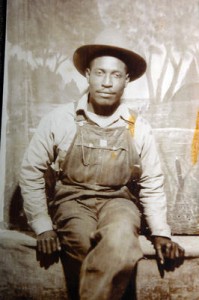
He was born April 15th, 1919 in Amite County, Mississippi. He had a seventh grade education. Allen served in the United States Army during World War II; he enlisted at age 23 in the service at Camp Shelby, Mississippi on January 12th, 1943. After his return to Mississippi, he worked as a logger and farm laborer. 

Allen and his wife Elizabeth had four children together, including a daughter and a son named Henry (called Hank). He built up his own logging business in Liberty, which was doing well enough also to buy his own land, where he and his family raised produce and cattle.

It was said that the Ku Klux Klan had a strong grasp on the town of Liberty. Around this time in the United States, wasn't the greatest in racial equality either. African-Americans were politically disfranchised by the Mississippi's constitution of 1890. Poll taxes, literacy tests, and grandfather clauses were used to raise barriers to voter registration and exclude blacks from voting. 

In the early 1960's, a local chapter of the NAACP was founded by E.W. Steptoe for the purpose of registering black voters. He was soon joined by Bob Moses of the Student Nonviolent Coordinating Committee (SNCC).

In August 1961, Moses filed charges against Billy Jack Caston, cousin to Sheriff Daniel Jones and son-in-law of pro-segregation state legislator E.H. Hurst, for an assault against him and other civil rights activists by a white mob. It was the first time that an African-American had legally challenged white violence in Amite County. The all-white jury acquitted Caston, and Moses was escorted to the county line, ostensibly for his own safety. Moses left the county in January 1962. Steptoe consulted with Justice Department agents in Jackson about intimidation tactics used by Hurst and other prominent whites in the town of Liberty.

Allen did not attempt to register to vote or become involved in the Movement until what he witnessed on September 25th, 1961. Allen watched as Hurst and Lee had a limited verbal exchange the Westbrook Cotton Gin. Lee, who stood with empty hands and an unlit cigarette in his mouth, was then shot and killed by Hurst.

Allen was then pressured by local law enforcement officials to lie about what had happened. He testified that he had seen Lee holding a tire iron with the intention of hitting Representative Hurst. A piece of iron was “found” under Lee’s body by the same authorities that had coerced Allen. The coroner’s jury exonerated Hurst the next day.

Later, Allen had been uncomfortable about his untruth and told fellow activists the real story behind Lee's killing.

“I did not want to tell no story about the dead, because you can’t ask the dead for forgiveness,” Allen told Bob Moses.

Allen also discussed the incident with Julian Bond, who encouraged him to tell his story to the FBI. 

After learning that a federal jury was to consider charges against Hurst, Allen talked to the FBI and the United States Commission on Civil Rights in Jackson, asking for protection if he testified. However, the Justice Department said it could not give him protection causing Allen to stick with the lie he had originally told.

Even though Allen ended up not cooperating, it was already too late, word had spread throughout Liberty about what he had tried to do. Whites stopped patronizing Allen’s business and cut off his credit. Deputy sheriff Daniel Jones, whose father was a Ku Klux Klan leader, began repeatedly arresting Allen on trumped up charges such as trespassing or writing bad checks. In one instance with Jones,  Jones struck Allen's face with a flashlight, breaking his jaw. 

 No black men had been allowed to vote in Amite County since 1890. In August 1962, as Allen and two other black men tried to register to vote at Amite County Courthouse, they were shot at by an unknown assailant. 

Following this incident, a white businessman threatened Allen, saying, "Louis, the best thing you can do is leave. Your little family, they're innocent people, and your house could get burned down. All of you could get killed."

Allen reported the death threats to the FBI, but they had limited jurisdiction over civil right at the time.

Leo McKnight was a friend of Allen's and had worked with him and twice tried to register to vote with him. In February 1963, McKnight and his family died in a suspicious fire that local blacks believed was a murder.

Allen wanted to leave town, but he had a sick mother to care for. After his mother passed away in January of 1964, he made plans to leave. On the 31st, the night before his planned departure, He was killed by two shotgun blasts to the head. Allen’s teenage son found his father’s dead body lying in the driveway. The entire left side of his face had been blown off. Deputy Jones, the same man who had threatened Allen’s life on numerous occasions, was made the lead investigator of the case. 

In 2011, Hank said, "He [Sheriff Daniel Jones] told my mom that if Louis had just shut his mouth, that he wouldn't be layin' there on the ground. He wouldn't be dead."

There was no real investigation into Allen's murder until 1994, when Plater Robinson, a history professor at Tulane University, began examining the case files. Robinson's research in the following years pointed to Jones as a likely suspect in the killing. In 1998, Robinson conducted a tape-recorded interview with Alfred Knox, an elderly black preacher in Liberty, who reported that Jones had recruited his son-in-law, Archie Weatherspoon, to "kill Louis Allen". When Weatherspoon refused to pull the trigger, Jones allegedly killed Allen himself. Both Knox and Weatherspoon have since died.

In 2007, the FBI reopened Allen's case. Its staff identified Jones as the prime suspect. As of 2011, the FBI has been unable to collect enough evidence to prosecute. 

Officially, Allen's murder remains unsolved today.

Who Killed Cindy Joy Elias After Leaving Sammy's Bar and Lounge in Virginia, Minnesota?

Cindy Joy Elias
Image result for Cindy Joy Elias
"In Gods Care"

She was vibrant, happy-go-lucky and a hard worker. She liked to help people.

She was born on December 17th, 1957 in St. Louis County, Minnesota to Edward Elias and Audrey Elaine Erlandson Elias. She was the youngest girl out of her seven siblings. She graduated from Paramount California high school in 1976. Cindy was a college student in Virginia, Minnesota, who planned to become a social worker.  She was working as a waitress at Virginia's Dutch Treat coffee shop at the Coates Motor Inn.

Cindy was last seen just after midnight on March 23rd, 1977 at Sammy's Bar and Lounge in Virginia, Minnesota. Acquaintances said Cindy was going to hitchhike home since none of her friends were in good enough shape to give her a ride. A day later, her body was discovered hidden under a pile of brush along a rural logging road just north of Aurora. An autopsy report indicated that she was killed by several massive blows to the head and died not long before her body was discovered. It is believed that the perpetrator or perpetrators are local people or truck drivers that were familiar with the area where she was found.

There was one guy at the bar that was never seen drinking and people thought he was a little weird. That is all i know about that.


If you have any idea what happened to her, please call the St. Louis County Sheriff’s Office at (218) 749-7134. There is a $50,000 reward for information leading to the arrest and conviction of the killer(s).

Cindy's body was exhumed on November 3rd, 2008 and examined by St. Louis County Medical Examiner Dr. Tom Uncini. I cannot find what led to the exhumation or whether any fruitful information has been gleaned.