Welcome To My Blog. I respect and appreciate comments, questions, information and theories you might have. Even if i agree with you or not, i won't delete your comments as long as they are not purposefully attacking anyone. I will not condone bullying of any kind. If you that is your intent, don't bother posting because i will delete it the moment i see it.
She disappeared on the evening of 3 May 2007 from her bed in a holiday apartment in Praia da Luz, in Portugal.
One newspaper called her disappearance as "the most heavily reported missing-person case in modern history".
Her whereabouts are unknown.
Timeline
2.29 p.m.: The last photograph of Madeleine is taken at the pool.
6 p.m.: Kate takes children back to apartment.
6.30 p.m.: Gerry asks David Payne, one of the so-called "tapas seven", to check on Kate and the children at the apartment.
7 p.m.: Gerry returns to the apartment and the children are put to bed in the front bedroom overlooking the car park and beyond it, the street.
Madeleine is placed in the single bed nearest the door.
There is an empty bed against the opposite wall beneath the window. Between the two beds are two travel cots containing the twins.
7.30 p.m.: The McCanns shower and change.
8 p.m.: The couple share a bottle of wine together.
8.35pm: The McCanns are the first of the group to arrive at the tapas restaurant, 50 yards away from their apartment.
8.55pm: The group has ordered starters when the routine of checking on the children begins. Matt Oldfield goes to check his own apartment.
He also tells the Paynes, who are still in their apartment, that the group is waiting for them at the restaurant.
9.05pm: Gerry returns to the apartment through the unlocked patio doors to check on the children.
He enters the apartment and sees that the children's bedroom door, which they always left slightly ajar.
Thinking this is odd, he glances into his own bedroom to see if Madeleine has gone into her parents' bed.
But he sees that all three are still fast asleep where the McCanns left them. This is the last time he would see his daughter.
9.08pm: Gerry sees Jeremy Wilkins, another tourist at the resort, on the opposite side of the road as he walks back to the tapas bar and crosses over to talk.
Wilkins and his partner are eating in their apartment since their youngest child will not settle.
9.10pm: Jane Tanner walks up the road, unnoticed by Gerry and Wilkins.
She spots a man walking quickly across the top of the road in front of her, going away from the apartment block and heading to the outer road of the resort complex.
He is carrying a sleeping girl in pink pajamas who is hanging limply in his arms.
Her daughter is fine; Tanner returns to the table.
9.30pm: Kate gets up to make next check on her children but Matthew Oldfield and Russell O'Brien are checking, too.
Oldfield offers to check the McCann's children.
In the McCanns' apartment, Oldfield notices the children's bedroom door is open again.
He merely observes all is quiet and makes a cursory glance inside the room seeing the twins in their cot, but not directly seeing Madeleine's bed. Afterwards, he could not say for sure if she had been there or not.
Nor could he say if the window and shutter had been open.
10.00pm: Kate checks on the children.
She becomes alarmed when she reaches out to the children's bedroom door and it blows shut. Inside the room, the window is open and the shutter is up. The twins are sleeping but Madeleine's bed is empty.
Shortly after 10pm: Rachael Oldfield goes to Tanner's apartment to tell her Madeleine has been taken.
Tanner says: "Oh my God. I saw a man carrying a girl."
10.15pm: Oldfield goes down to the 24-hour reception at the bottom of the hill to raise the alarm.
Police are called.
10.30pm: Local police are first to arrive on the scene.
11.10pm: Detectives from the Policia Judiciaria (PJ) arrive having been contacted by police constables.
Around 4.00am: Physical search for Madeleine is called off, according to witnesses.
Detectives from the PJ leave
Interesting....
There was never any evidence that Madeleine was abducted, just the claim by her parents.
The crime scene was never secured.
Cadaver dogs found the scent of blood and a dead body in the McCann's apartment in the closet and behind the couch.
On some of Madeliene's clothes.
The parents washed Madeliene's stuffed animal she was sleeping with when she disappeared.
The cadaver dogs still found traces of a dead body on that as well.
Who washes their missing child's stuffed animal right away or at all?
Curious
Also the dogs found blood and dead body smell in the rented car.
The only prints on the window was that of Kate.
It was impossible for the abductor to go through the window, without supporting themselves on the bed.
There was no trace dragging anything or body through the window.
Gerry admitted to using some kind of sleep aid for Madeliene in the past.
The Smith Family's statements that identified Gerry as the man they saw carrying a child fitting Madeleine's description towards the beach.
Kate didn't physically search for Madeleine, she sat in the bedroom deleting calls and text messages from her mobile phone.
Kate McCann refused to answer 48 questions in a police interview which could have helped find her missing daughter.
The fund set up to find Madeliene was partially used to pay the McCann's Mortgage.
On May 1, 2 days before Madeleine was reported missing the McCann's upstairs neighbor Mrs Fenn had heard Madeleine crying hysterically for an hour and fifteen minutes.
May 4, 2007 when the police took pictures of the apartment there was Madeleine's pink blanket and Gerry's blue sports bag. Both had disappeared from the apartment.
A few days after Madeleine had disappeared Father Pacheco gave the McCann's keys to his church.
7 months later he told friends that he had been deceived, he claimed the McCann's had deceived him and had caused him numerous problems.
He removed all traces of Madeleine from his church.
Investigators were convinced Kate had confessed to him but he insisted he would stand by his priestly vow and take whatever she had said to his grave.
What i think happened.
I believe Madeliene heard the dad talking under the window to his friend.
She was a little groggy, but she was awake and already out of bed.
She went over to the couch and climbed up on it.
She tried to peer out the window and hit her head.
Some one checking on the kids, possibly Gerry, went and discovered Madeliene after discovering she wasn't in her bed.
They possibly hid her in the closet, before getting assistance in hiding her body.
Or Gerry took her body down to the ocean.
That is why Jane said she saw someone carrying a girl, and the description she gave somewhat matched Gerry.
They were trying to cover their tracks.
I think if they searched Cape St. Vincent, they might find her.
What do you think happened?
i think they need to at least be charged for endangering all of their children.
Evidence that Madeleine died in the apartment.
Possible Madeleine sighting
I like how she did this video of this case.
The video the Mccann's apparently didn't want anyone to see.
Kyron was very shy and reserved. He would always stick by his mother's side. He was always afraid to go anywhere alone and would have panic attacks just thinking about it.
He was born September 9th, 2002 to Desiree and Kaine Horman. Before he was born, his parents were already broken up and Kaine was with Terri Moulton. Kaine had an affair with Terry while he was still married to Desiree. By the time Kyron was two years old, Kaine had full custody of him. Desiree was going through liver failure and she had to travel to Canada to get treatment. With a long road to recovery, that is why Desiree gave Kaine full custody. Kaine had a busy full time job, so Terri spent a lot of time with Kyron. Terri would call Desiree often to ask her if she would spend time with Kyron. Desiree claims that Terri didn't really want to spend time with Kyron and was desperate to drop him off. Desiree wanted Kyron to come back and live with her, but Kaine thought it wasn't a good idea. Kyron would cry all night, every night for his mother. Desiree believes that there was something going on between Kyron and his stepmom.
Terri developed a drinking problem. One day she was found passed out on the couch by her young daughter. In 2005, Terry was on her way home driving on the interstate 5 highway. Her son James, who was 11 years old at the time, was in the back seat. The car was weaving back and forth at different speeds. A cop pulled her over and found out that she was sloppy drunk with a kid in the back. Terri had a blood alcohol level of 0.15, which was almost double the legal limit. She was charged with reckless child endangerment and a DUI, which she plead guilty too. She was ordered to enroll in a rehabilitation program. It was 2010, Kaine and Terri were having marital problems and Terri was planning on leaving Kaine on June 4th.
Kyron went missing after not returning home from Skyline Elementary School in Portland, Oregon, on June 4th, 2010. Kaine said that it started out as a normal day. He gave his son a hug and told him that he loved him before Kyron went off with Terri to school around 7:30 a.m. She said that he was excited about his project and wanted to show it off. Terri said that they arrived at school around 8 a.m. and they went to the gym were the science fair displays were being set up.
8:15 a.m. is when Kyron was reportedly seen by the PTA president, standing by his science fair project.
Terri said she stayed with him while he attended a science fair. She stated that she left the school at around 8:45 a.m. She said she remembered seeing Kyron walking down the hall to his first class while she was standing on the stairs waving to him. With the layout of the school the way it was, it was impossible for Terri to see Kyron from the stairs.
A student claims that Kyron by the south entrance of the school around 9 a.m. That was the last person to allegedly see Kyron besides Terri. He was never seen in his first math class; instead, and was marked absent that day. He has not been seen since.
Terri (The one and only suspect)
Terri said that after she left the school she went to a Fred Meyer grocery store to get the toddler medicine. Terri had a receipt and surveillance footage proving that she was there at 9:12 a.m. and another Fred Meyer after.
Terri then claimed that between 10:00 a.m. and 11:40 a.m. she was drove her daughter around town in an attempt to use the motion of the vehicle to soothe the toddler's earache.
Allegedly, Terrie's cellphone pinged at Sauvie Island. Sauvie Island, in the U.S. state of Oregon, originally Wapato Island or Wappatoo Island, is the largest island along the Columbia River, at 26,000 acres, and one of the largest river islands in the United States.
Terri check to a local gym at 11:40 a.m. and put her daughter in the daycare there. She claimed that she worked out until about 12:40 p.m.
By 1:21 p.m., she had arrived home and posted photos of Kyron at the science fair on Facebook. At 3:30 p.m., Terri, her husband Kaine, and their daughter, Kiara, walked to the bus stop to meet Kyron. The bus driver informed them that Kyron had not boarded the bus after school. She then called the school to ask where he was.The school secretary informed her that Kyron hadn't been in school since early that day and had been marked absent. Realizing the boy was missing, the secretary then called 9-1-1. By 4:33 p.m., the police show up at the school and at Kyron's home. A 8:09 p.m., search teams scoured the school grounds for any sign of Kyron. This is about 12 hours after he was last seen and any potential evidence could have been lost or seriously degraded. By 10:40 p.m., the search was complete of the school and the surrounding property. No clue as to what happened to Kyron was found. The search of Kyron's home generated no results either. The FBI and National Guard joined the efforts. A second search of the school was done the next day, along with a search of the Oregon wilderness. Search dogs were even used, no clues were found. Kyron's school staff and students were all questioned as well as Terri and Kaine. When questioned, one of the teachers said that Terri had told her that Kyron was not going to be to school that day. Police also learned that all of the doors of the school had been unlocked and people were able to walk freely through the school without signing in. It was estimated that around 400 people had went through the school. At first Kaine defended Terri as a kind and attentive mother, but quickly his suspicions grew and he couldn't stand by her any longer. Desiree was always suspicious of Terrie ever since neither she or Kaine called to inform her that her son was missing. Desiree found out from the school 8 hours after Kyron was last seen. Wednesday, June 9th, 2010, police had a press conference about Kyron's disappearance. They announced they had no new leads in the case. That day Terri posted on her personal Facebook page, "Hitting the gym tomorrow. i didn't home until 8 p.m. tonight."
Terry has long been the focus on investigators after admitting she failed two lie detector tests, but she was never charged.
She has always claimed she had nothing to do with Kyron's disappearance.
"I personally believe the stepmom has something, some knowledge of what happened to Kyron,” said victim’s rights advocate John Walsh
She did what now?
In the middle of the investigation into Kyron's disappearance, Kaine Horman was reportedly told by investigators that Terri had offered their landscaper, Rodolfo Sanchez, "a lot of money" to kill him. Sanchez testified in a deposition that Terri approached him five months before Kyron's disappearance to help kill her husband.
Investigators convinced Sanchez to wear a wire and talk to Terri, but they got nothing.
On June 28, Kaine filed for divorce and obtained a restraining order against Terri.
Investigators found out that Terri was having an affair with Kaine's high school friend, Michael Cooke. The day that Kyron went missing she was sexting Michael. They also found out that Terri's best friend, Dee Dee was missing for the same 90 minutes that Terri was on the day of Kyron's disappearance. She was supposed to be landscaping in German town, across town from Kyron's school. When the homeowner came out to talk to her, her truck was there but she wasn't. He tried to call her phone, but it was turned off. He searched everywhere for her, but she was nowhere to be seen. Dee Dee also helped Terri by an untraceable phone. Also, there were eye witness accounts claiming that there was an unidentified person in Terri's truck. Could it have been Dee Dee?
And then she.....
Police in California arrested Terri in 2016 after she left the Dr. Phil show. Officers in Marysville said she stole a gun from her roommate. She was booked in the Yuba County Jail on July 4, 2016. She posted bail. A couple days before Christmas, Terri was arrested again.This time for driving a stolen car in a town just outside of San Francisco. She was booked in the Marin County Jail and soon after posted bail.
Updates
Police in Roseburg confirm detectives are investigating an alleged murder-for-hire plot involving Terry that dates back decades.
Terry’s ex-boyfriend said she allegedly tried to have him killed in 1990. No charges have been filed yet.
Detectives hope a digital trail will help provide clues into the whereabouts of Kyron Horman.
Police recently examined a laptop computer that used to belong to Kyron’s stepmother, Terri Horman.
“They are working computer forensic information and evidence that they’ve gotten that’s come to light recently,” Said Kyron's mom Desiree.
On June 2, 2018, the eight-year anniversary of the Kyron's disappearance, his mom Desiree Young wrote on Facebook, “Stay tuned, something big is coming, I promise you.”
She also referenced Kyron's stepmother, Terri, in the post, saying "she is not going to get away with staying silent about where her son is."
“I’ve had that dream of Kyron coming home. It’s so vivid,” explained Kyron’s mother Desiree Young. “I’m hoping our day is soon.”
She was born July 29, 1924 in Boston Massachusetts.
She was an aspiring actress.
She was found murdered in the Leimert Park neighborhood of Los Angeles, California.
Before
Her father's car was found abandoned on the Charlestown Bridge in 1930.
It was assumed that he had committed suicide by jumping into the Charles River.
Troubled by bronchitis and severe asthma attacks, Elizabeth underwent lung surgery at age fifteen.
In late 1942, Elizabeth's mother received a letter of apology from her presumed-deceased husband.
He was alive and had started a new life in California.
In December, at age eighteen, Elizabeth relocated to Vallejo to live with her father.
In January 1943, arguments between Elizabeth and her father led to her moving out.
Short returned to her home in Los Angeles after a brief trip to San Diego with Robert "Red" Manley.
He was a 25-year-old married salesman she had been dating.
Robert stated he dropped Elizabeth off at the Biltmore Hotel located at 506 South Grand Avenue in downtown Los Angeles.
Elizabeth was to meet her sister, who was visiting from Boston, that afternoon.
The staff of the Biltmore recalled seeing Elizabeth use the lobby telephone.
Shortly after, she was allegedly seen by patrons of the Crown Grill Cocktail Lounge at 754 South Olive Street.
It was approximately 1⁄2 mile away from the Biltmore Hotel.
Discovery
January 15, 1947, Elizabeth's body was found on a vacant lot on the west side of South Norton Avenue, midway between Coliseum Street and West 39th Street in Leimert Park, Los Angeles.
The area was largely underdeveloped at the time.
Resident Betty Bersinger was walking with her three-year-old daughter when she discovered the body at approximately 10:00 a.m.
Elizabeth's naked and severely mutilated body was completely severed at the waist and drained entirely of blood, leaving its skin a pale white.
Medical examiners determined that she had been dead for around ten hours.
Her time of death was either sometime during the evening of January 14, or the early morning hours of January 15.
The body had been washed by the killer.
Her face had been slashed from the corners of her mouth to her ears.
Long gashes extended her mouth into an eerie smile.
That created an effect known as the "Glasgow smile".
She had several cuts on her thigh and breasts.
Entire portions of flesh had been sliced away.
The lower half of her body was positioned a foot away from the upper.
Her intestines had been tucked neatly beneath her butt.
The corpse had been "posed", with her hands over her head.
Her elbows bent at right angles.
Her legs spread apart.
Detectives located a heel print near the body on the ground amid tire tracks.
A cement sack containing watery blood was also found nearby.
Autopsy
Her autopsy was preformed on January 16, 1947, by Dr. Frederick Newbarr, the Los Angeles County coroner.
The report stated that Elizabeth was 5 feet 5 inches tall, weighed 115 pounds.
She had light blue eyes, brown hair, and badly decayed teeth.
There were ligature marks on her ankles, wrists, and neck.
There was an "irregular laceration with superficial tissue loss" on her right breast.
There were superficial lacerations on the right forearm, left upper arm, and the lower left side of the chest.
Her official cause of death was a cerebral hemorage.
Media
The graphic nature of the crime and the subsequent letters, resulted in a media frenzy surrounding Elizabeth's murder.
Both local and national publications covered the story heavily.
The Examiner describing the black tailored suit Short was last seen wearing as "a tight skirt and a sheer blouse"
Media nicknamed her as the "Black Dahlia".
They described her as an "adventuress" who "prowled Hollywood Boulevard".
Reports about Elizabeth's personal life were publicized.
Details about her alleged declining of Hansen's romantic advances.
A stripper who was an acquaintance of Elizabeth's told police that she "liked to get guys worked up over her, but she'd leave them hanging dry."
Additional newspaper reports, such as one published in the Los Angeles Times on January 17, deemed the murder a "sex fiend slaying".
Some reporters and detectives looked into the possibility that Elizabeth was a lesbian.
They begin questioning employees and patrons of gay bars in Los Angeles.
This claim, remained unsubstantiated.
Investigation
A person claiming to be Elizabeth's killer placed a phone call to the office of James Richardson, the editor of the Los Angeles Examiner, on January 21, 1947.
He congratulated Richardson on the newspaper's coverage of the case.
He also stated he planned on eventually turning himself in.
The caller told Richardson to "expect some souvenirs of Beth Short in the mail".
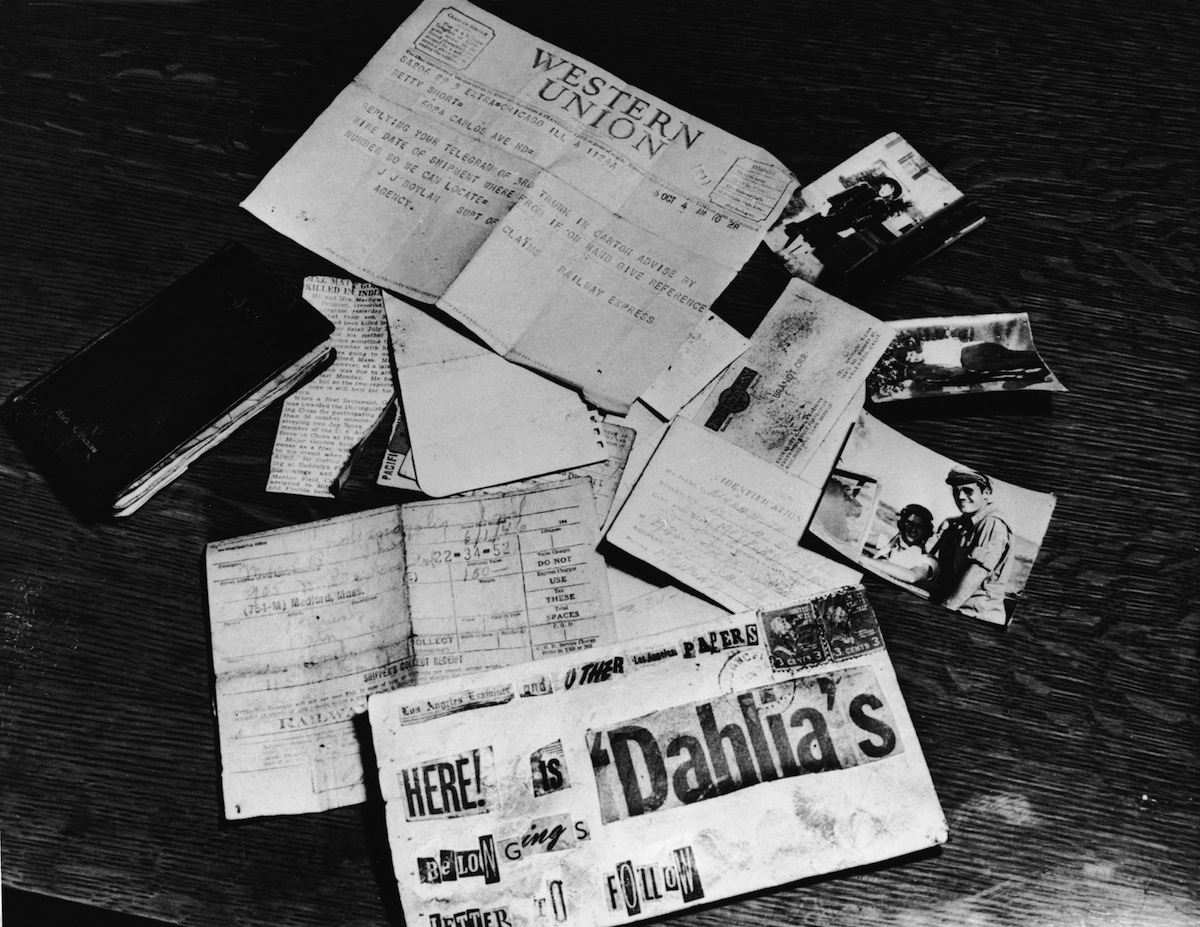
A suspicious manila envelope was discovered by a U.S. Postal Service worker, on January 24.
The envelope had been addressed to "The Los Angeles Examiner and other Los Angeles papers".
It had individual words that had been cut-and-pasted from newspaper clippings.
The envelope contained Elizabeth's birth certificate, business cards, photographs, and names written on pieces of paper.
There was also an address book with the name Mark Hansen embossed on the cover.
Like Elizabeth's body, the packet had been cleaned with gasoline.
This led the police to believe that the packet was sent directly from her killer.
Several partial fingerprints were lifted from the envelope and sent to the Federal Bureau of Investigation for testing.
The prints were compromised in transit, so they couldn't be properly analyzed.
The same day the packet was received by the Examiner, a handbag and a black suede shoe were reported to have been seen on top of a garbage can in an alley a short distance from Norton Avenue.
That was 2 miles from where Elizabeth's body had been discovered.
The items were recovered by police, but they had also been wiped clean with gasoline.
There was no salvageable prints.
The Second Letter
Another letter was received by the Examiner, on January 26.
This time it was a handwritten.
It read:
"Here it is. Turning in Wed., Jan. 29, 10 am.
Had my fun at police. Black Dahlia Avenger".
The letter also named a location at which the supposed killer would turn himself in.
On the morning of January 29, The police waited at the location.
The alleged killer did not appear.
At 1:00pm, The Examiner offices received another cut-and-pasted letter.
The letter read:
"Have changed my mind. You would not give me a square deal. Dahlia killing was justified."
The Los Angeles Herald-Express also received several letters from the supposed killer.
The letters again were made with cut-and-pasted clippings.
Lead investigator Captain Jack Donahue told the press that he believed Elizabeth's murder had taken place in a remote building or shack on the outskirts of Los Angeles.
He also believed her body transported into the city where it was disposed of.
The LAPD looked into the possibility that the murderer may have been a surgeon, doctor, or someone with medical knowledge, based on the precise cuts and dissection of Short's corpse.
The LAPD served a warrant to the University of Southern California Medical School in mid-February 1947.
It was located near the site where Short's body had been discovered.
The warrant requested a complete list of the program's students.
The university agreed so long as the students' identities remained private.
Background checks were conducted, but they yielded no results.
Sgt. Finis Brown, on the various dead ends in the case said:
"No lead had any conclusions. Once we'd find something, it seemed to disappear in front of our eyes."
The Los Angeles Police Department interviewed over 150 men in the ensuing weeks whom they believed to be potential suspects.
Profile
The police were convinced that the killer knew Elizabeth, due to the mutilations present on Elizabeth’s corpse, which were signs of a personal vendetta.
The killer wanted the world to see Elizabeth and the wrongdoings that they believed she had done to them.
They were a sadist who wanted to dominate Elizabeth.
It was also suggested the killer might have been a necrophiliac.
Suspects
Robert Manley
He had been one of the last people to see Elizabeth alive.
He was a medical student.
They were dating.
He was married.
He was also investigated, but was cleared of suspicion after passing numerous polygraph examinations.
Mark Hansen
Mark Hansen was the owner of the address book found in first packet.
Police quickly deemed him a suspect.
He was a wealthy local nightclub and theater owner.
He was an acquaintance at whose home Elizabeth had stayed with friends.
He confirmed that the shoe and the purse discoverd in the alley were Elizabeth's.
Ann Toth was Elizabeth's friend and roommate.
She told investigators that Elizabeth had recently rejected sexual advances from Hansen.
She suggested it as potential cause for him to kill Elizabeth.
Con Keller was a member of LA's Gangster Squad investigating the case.
Keller believed Hansen was the killer.
He said Hansen had spent some time at a Medical surgical school in Sweden which would explain the precise dissection of Elizabeth's body.
Keller also said that Hansen would have elaborate parties at his Hollywood house.
The members of the Los Angeles Police Department along with the Chief of Detectives would attend and perhaps later aided Hansen in a cover up.
Hansen was cleared of suspicion in the case.
Police also interviewed several persons found listed in Hansen's address book.
Martin Lewis
He was in Hansen's address book.
He had been an acquaintance of Elizabeth's.
Lewis was able to provide an alibi for the date of Short's murder.
He was in Portland, Oregon visiting his father-in-law, who was dying of kidney failure.
George Hill Hodel
Steve Hodel says his father was Elizabeth's killer.
He presented his father's training as a surgeon as circumstantial evidence.
Crime scene photos showed that Elizabeth had been given a hemicorporectomy.
This is a procedure that slices the body beneath the lumbar spine.
That is the only spot where the body can be severed in half without breaking bone.
It was taught in the 1930s, when George Sr. had been in medical school.
The letters sent to the press and police from The Black Dahlia Avenger, also had a chilling resemblance to his dad’s handwriting.
A handwriting expert determined that there was a strong likelihood that his father’s handwriting matched the script on some of the notes the killer sent to the LAPD, but the results were inconclusive.
He also went through his fathers things.
There were two pictures of a young woman, her eyes cast downward, with curly, deep-black hair.
Steve still doesn’t know why he had the idea, but as he looked at the images, he thought to himself:
“My God, that looks like the Black Dahlia.”
Steve found a folder in the archives of UCLA, containing receipts for contracting work on his childhood home.
One of the receipts showed a purchase a few days before Elizabeth's murder of 10 five-pound bags of concrete.
It was the same size and brand found near Short’s body that police believe her killer used to carry her.
Steve tracked down a policewoman who reported seeing Elizabeth on the night before she was found murdered, on the street with a man and a woman.
Half a century later, the cop could only remember what Elizabeth looked like, not the two other people present.
It was revealed in 2003, notes from the 1949 grand jury report that investigators had wiretapped Hodel's home.
On 19 February 1950, there’s a haunting exchange.
8:25pm. “Woman screamed. Woman screamed again."
Later in the day, Hodel talks to a confidant.
“Realise there was nothing I could do, put a pillow over her head and cover her with a blanket.
Get a taxi.
Expired 12:59.
They thought there was something fishy.
Anyway, now they may have figured it out. Killed her.”
"Supposin' I did kill the Black Dahlia. They couldn't prove it now. They can't talk to my secretary because she's dead."
George Knowlton
In 1991, Janice Knowlton, a woman who was ten years old at the time of Elizabeth's murder, claimed that she witnessed her father, beat Elizabeth to death with a clawhammer in the detached garage of her family's home in Westminster.
In 1995, she also published a book titled Daddy was the Black Dahlia Killer.
In the book she made additional claims that her father sexually molested her.
Janice's stepsister, Jolane Emerson, condemned the book, in 2004.
She deemed it "trash", saying:
"She believed it, but it wasn't reality. I know, because I lived with her father for 16 years."
LAPD homicide detective John P. St. John told the Los Angeles Times that Janice's claims were "not consistent with the facts of the case".
The Man in the Sedan
Ralph Asdel was one of the original detectives on the case.
In 2003, he told the Los Angeles Times that he believed he had interviewed Elizabeth's killer.
He was a man who had been seen with his sedan parked near the vacant lot where Elizabeth's body was discovered.
A neighbor driving by that day stopped to dispose of a bag of lawn clippings in the vacant lot.
He saw a parked sedan, allegedly with its right rear door open.
The driver of the sedan was standing in the lot.
His arrival apparently startled the owner of the sedan.
The man approached his car and peered in the window before returning to the sedan and driving away.
The owner of the sedan was followed to a local restaurant where he worked.
He was ultimately cleared of suspicion.
Connections
Jack Anderson and The Cleveland Torso Murders
Some journalists and law enforcement have speculated a connection between the 1936 Cleveland Torso Murders.
The original LAPD investigators studied the Cleveland murders in 1947.
Then later discounted any relationship between the two cases.
New evidence, in 1980, implicating a former Cleveland torso murder suspect, Jack Anderson Wilson (a.k.a. Arnold Smith), was investigated by Detective John P. St. John in relation to Elizabeth's murder.
The detective claimed he was close to arresting Wilson for Short's murder.
February 4, 1982, Wilson died in a fire.
When profiled on the series Unsolved Mysteries in 1992, Eliot Ness biographerm Oscar Fraley suggested Ness knew the identity of the killer responsible for both cases.
The Murder of Jeanne French
The murder of Jeanne French in February 10, 1947 Los Angeles, was also considered by the media and detectives as possibly being connected to Elizabeth's killing.
French's body was discovered in west Los Angeles on Grand View Boulevard.
She was nude and badly beaten.
Written on her stomach in lipstick was what appeared to say "Fuck You B.D.", and the letters "TEX" below.
The Herald-Express covered the story heavily, and drew comparisons to the Elizabeth's murder less than a month before.
Saying the initials "B.D." to stand for "Black Dahlia".
According to historian Jon Lewis, the scrawling actually read "P.D.", standing for "police department".
Captain Donahoe of the LAPD stated publicly that he believed the Black Dahlia and the Chicago Lipstick Murders were "likely connected".
Suzanne Degnan's Murder
Son of George Hill Hodel, crime author Steve Hodel and fellow crime author William Rasmussen and others, have suggested a link between Elizabeth's murder and the 1946 murder and dismemberment of six-year-old Suzanne Degnan in Chicago, Illinois.
Some evidence is the fact that Elizabeth's body was found on Norton Avenue, three blocks west of Degnan Boulevard, Degnan being the last name of the girl from Chicago.
There were also similarities between the handwriting on the Degnan ransom note and that of "the Black Dahlia Avenger".
Both texts used a combination of capitals and small letters.
Both notes contain a similar misshapen letter P and have one word that matches exactly.
Hector Verburgh, was a janitor in the building where the Degnans lived.
He was originally arrested for her murder.
He was released several days later with no charges and was later awarded $20,000 for false arrest and police brutality in 1948.
Convicted serial killer William Heirens served life in prison for Degnan's murder, along with two others.
He was arrested at 17 for breaking into a residence close to that of Degnan.
He claimed he was tortured by police, forced to confess, and made a scapegoat for Degnan's murder.
He taken from the medical infirmary at the Dixon Correctional Center on February 26, 2012 for health problems.
He died at the University of Illinois Medical Center on March 5, 2012, at age 83.
The murder of Georgette Bauerdorf
She was a socialite who was strangled to death in her West Hollywood home in 1944.
John Gilmore's 1994 book Severed: The True Story of the Black Dahlia Murder, suggests a possible connection between Elizabeth's murder and the murder of Georgette Bauerdorf.
He suggests that Elizabeth's employment at the Hollywood Canteen, where Bauerdorf also worked as a hostess, could be a connection between the two women.
The claim that Elizabeth ever worked at the Hollywood Canteen has been disputed by those such as Los Angeles Times editor Larry Harnisch.
Leslie Dillion
Leslie was a bellhop who was a former mortician's assistant.
The Black Dahila, Red Rose by Piu Eatwell, a 2017 book , focuses on Leslie Dillon and his associates Mark Hansen and Jeff Connors.
It alleges that Sergeant Finis Brown, one of the lead detectives who had links to Hansen, was corrupt.
The book says that the motive for the killing was that Elizabeth knew too much about the men's involvement in a scheme for robbing hotels.
The book also suggests Elizabeth was killed at the Aster Motel in Los Angeles.
The owners said that on January 15, 1947, they found one of the motel's rooms "covered in blood and fecal matter".
The Los Angeles Examiner had stated in 1949 that LA Police Chief WIlliam A. Worton denied that the Flower Street (Aster) Motel had anything to do with the case.
Eatwell is working on a TV documentary for Peacock Productions.
She has a revised edition of her book due to be released in the Fall of 2018.
Buz Williams, a retired detective with the Long Beach Police Department,in 2000, wrote an article for the LBPD newsletter The Rap Sheet on Elizabeth Short's murder.
Williams' father Richard F. Williams and his friend Con Keller were both members of LA's Gangster Squad investigating the case.
Williams Sr believed that Leslie Dillon was the killer.
He believes that when Dillon returned to his home state of Oklahoma was able to avoid extradition to California because Dillon's relative was the governor of Oklahoma.
An exhaustive investigation and that the LA District Attorney’s files positively placed Dillon in San Francisco when Elizabeth Short was killed.
There were suspects remaining under discussion by various authors and experts.
The suspects included Walter Bayley, Norman Chandler (whom biographer Donald Wolfe claims impregnated Elizabeth),Joseph A. Dumais, Artie Lane (a.k.a. Jeff Connors), Dr. Francis E. Sweeney, George Hill Hodel's friend Fred Sexton, and Patrick S. O'Reilly.
Curious
When the Black Dahlia case struck, Agness Underwood had been with The Herald-Express for twelve years.
An LAPD homicide detective-lieutenant, Ray Giese, pushed Agness in the direction of Elizabeth Short’s case while the LAPD continued to search down leads.
She covered the interview for the first suspect arrested in Elizabeth Short’s murder, Robert M. “Red” Manley.
The following morning, Agness was suddenly taken off the case.
One theory behind why she had been removed from the Black Dahlia case is that she was getting too close to finding out the truth behind Elizabeth Short’s murder.
In 1949 when the Black Dahlia case was still open, the Grand Jury was convened to both investigate Elizabeth Short’s murder and evaluate the possibility of police corruption or cover-up.
With the evidence presented, the 21 jurors named Leslie Dillon as the prime suspect.
Dillon was never indicted.
There was plenty of circumstantial evidence to name him as Elizabeth’s murderer.
Dillon had been illegally detained.
There also had been a lack of concrete evidence.
So he was never brought to trail.
In the event of a trial actually occurring, a few witnesses were willing to come forward.
They were willing to say Dillon was in San Francisco during the time of the murder.
The 1949 Grand Jury said this on the police corruption.
“Deplorable conditions indicating corrupt practices and misconduct by some members of the law enforcement agencies in the county… alarming increase in the number of unsolved murders… jurisdictional disputes and jealousies among law enforcement agencies.”
The Grand Jury, to this day, has never indicted a suspect for the murder of Elizabeth Short.
The Grand Jury findings did bring light police corruption at the highest ranks.
Case information often were not be passed on properly.
The Police Chief Clemence Horrall was dissmissed from the LAPD.
After
The majority of the physical evidence has been lost over the years.
Most of the witnesses are dead, as are the original cops that worked the case.
Elizabeth's whereabouts in the days leading up to her murder and the discovery of her body are unknown.
Her grave his Oakland, California.
Two weeks after Elizabeth's murder, California Republican assemblyman C. Don Field was prompted by the case to introduce a bill calling for the formation of a sex offender registry.
The state of California became the first U.S. state to make the registration of offenders mandatory.
Who do you think killed the Black Dahlia?
i think it was Dillon or Hodel.
Doesn't Hodel look like a product of Groucho Marks and Shia lebouf?
It is an extinct giant goanna or monitor lizard of the open forests, woodlands and perhaps grassland.
It ate meat, including mammals, snakes, other reptiles and birds.
It was twice as long as it's nearest living relatives of Megalania, the Komodo Dragon of the Flores Islands in Indonesia.
It appears to have disappeared around 40,000 years ago.
It was said to have lived in Australia.
They could weigh up to 4,280 pounds.
It had poisonous saliva, containing blood thinner, causing it's victim's to bleed to death.
The first aboriginal settlers of Australia might have been a factor in their extinction.
Titanaboa
Over 48 foot long snake known to have lived in Columbia.
It is the largest snake to every have existed.
Weighed up to 2,500 lbs.
The Kraken
Colossal squid
46 feet in length and 1,1650 lbs.
It's limbs are lined with sharp hooks, each having three points.
It has the largest eyes out of any documented animal ever.
It was found a 1,000 kilometers from Tokyo.
They are still alive to this day.
Moby Dick
Sperm whale "Moca Dick"
A male sperm whale that lived in the Pacific Ocean in the early 19th century, usually encountered in the waters near Mocha Island, off the central coast of Chile. Destroyed over 100 whaling ships.
He was killed in 1838, after he appeared to come to the aid of a distraught cow whose calf had just been slain by the whalers. His body was 70 feet long and yielded 100 barrels of oil, along with some ambergris—a substance used in the making of perfumes and at times worth more per ounce than gold. He also had nineteen harpoons in his body.
Vampires
Vlad the Impaler"Dracula"
Known as a madman, though in his native land he is revered as a savior from Turkish domination.
He was a Romanian prince
He would torture and kill enemies by impaling them.